
A damaged item doesn’t automatically mean a removalist is liable. In Australia, removalists must provide services with due care and skill under Australian Consumer Law, but responsibility depends on what happened and the evidence. This guide has removalist damage insurance explained in practical terms, including the difference between a damage claim and insurance cover.
Finding a cracked, dented or broken belonging after a move is unsettling, especially when you trusted it to be handled carefully. Knowing what your cover says, what evidence to keep and how to report damage can make the next steps clearer.
Learn how to assess your cover, record the value and condition of your belongings, and support a repair or replacement claim. We also explain what to do if damage may have resulted from the moving company’s packing.
Key Takeaways
- Record visible damage on delivery paperwork, take clear photos and keep the item and packaging while your claim is being assessed.
- Compare the cover’s exclusions, excess and valuation method so you understand what a payout may be based on.
- Gather receipts, inventory records and other proof of an item’s original value to support your repair or replacement claim.
- If poor packing may have caused the damage, document how the item was packed and connect that evidence to the damage you found.
1. Repair-or-replacement claims and supporting evidence
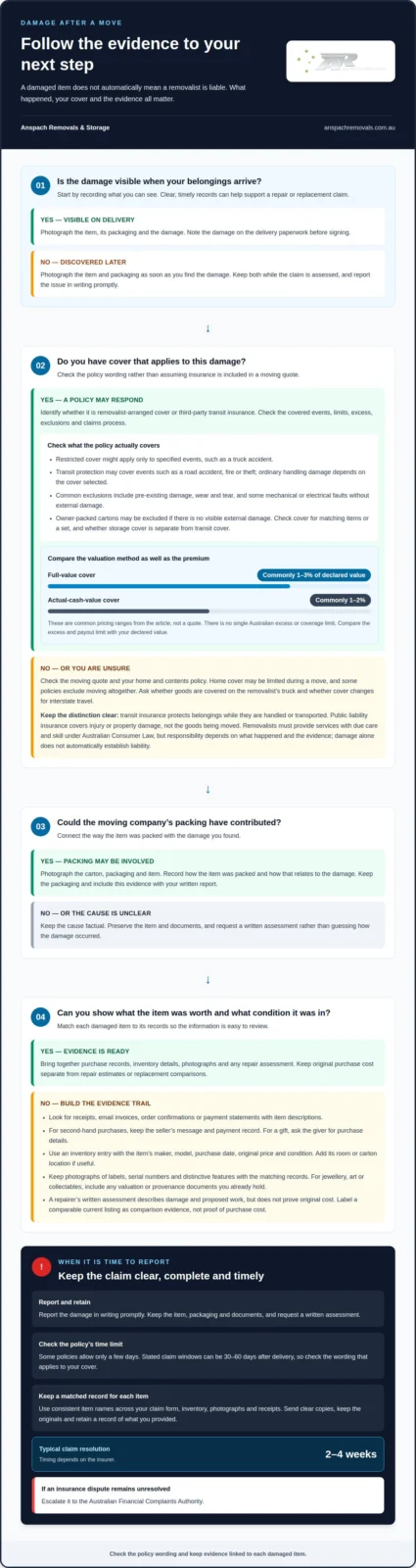
Removalists aren’t automatically liable for every damaged item. In Australia, services must be provided with due care and skill under Australian Consumer Law. Responsibility depends on what happened, the evidence and the cover involved. Transit insurance protects belongings while they’re handled or transported; public liability insurance covers injury or property damage, not the goods being moved.
For a clear explanation of removalist damage insurance, first distinguish removalist-arranged cover from third-party transit insurance. Either may protect belongings during a move, but the policy wording sets out covered events, limits, exclusions and the claims process. Restricted cover, for example, might apply only to specified events such as a truck accident.
There’s no single Australian excess or coverage limit. Full-value cover is commonly priced at 1-3% of declared value; actual-cash-value cover is commonly 1-2%. Compare the excess and payout limit with your belongings’ declared value, not just the premium.
Common exclusions include pre-existing damage, wear and tear, and some mechanical or electrical faults without external damage. Owner-packed cartons may be excluded if there’s no visible external damage. Check whether the policy covers matching items or a set, and whether storage cover is separate from transit cover.
Having removalist damage insurance explained in practical terms helps, but keep to the claim steps too. Photograph the item, packaging and damage, and note visible damage on delivery paperwork before signing. Report it in writing promptly, retain the item and documents, and request a written assessment. Some policies allow only a few days; stated claim windows can be 30-60 days after delivery. Claims typically resolve in 2-4 weeks, depending on the insurer. Escalate unresolved insurance disputes to the Australian Financial Complaints Authority.
2. Assessing coverage needs and risk tolerance
Depending on its wording, removalist cover can protect belongings against loss or damage during handling and transport. Transit protection may cover events such as a road accident, fire or theft, while ordinary handling damage depends on the cover selected. Start by assessing what you’re moving, its value and how difficult it would be to replace.
Don’t assume insurance is included in a standard moving quote. The quote should distinguish cover included in the service from optional insurance. Read each line and identify the policy, limits, excess and exclusions. A household with few costly items may accept narrower protection, while an expensive artwork or collection may call for broader cover.
Review your home and contents policy too. It may provide limited cover during a move, while some policies exclude moving altogether. Ask your insurer whether belongings are covered on the removalist’s truck, whether cover changes for interstate travel, and whether the insurer needs your moving date and new address. Jewellery, art and collectables may need to be listed separately. Declare the goods’ full value, as under-declaring can reduce a payout proportionally.
Match the cover to your belongings and the journey. A replaceable chair presents a different risk from a one-off artwork. Some policies classify particle-board and flat-pack furniture as fragile or high-risk. For an interstate move, find out whether belongings stay on one truck door to door and whether the same cover applies throughout. Keep valuables, documents and irreplaceable items with you in your car.
If you’re packing your household yourself, include suitable cartons in your plan. Moving boxes can help you organise items before the move, while fragile or high-value belongings deserve particular care. Consider how packing choices may affect the cover that applies to your goods.
3. Evidence of belongings’ original value
For each damaged item, provide evidence of its original cost. A receipt is useful, but keep other purchase records too, such as email invoices, order confirmations and payment statements with item descriptions. For second-hand purchases, retain the seller’s message and payment record. These records help establish what you owned and what you paid.
Create an inventory before moving day, with one entry per valuable item. Record its maker, model, purchase date, original price and condition. Add its room or carton location if that helps identify it later. For example, “oak dining table, purchased 2021” is clearer than “table”. Attach the receipt or other cost evidence to the matching entry.
Photograph labels, serial numbers and distinctive features while each item is accessible. Keep the images with purchase records rather than scattered across devices. For jewellery, artwork or collectables, include any valuation or provenance documents you already hold. If an item was a gift, ask the giver for its receipt or purchase details. Note its make and model, and don’t guess its price from memory.
Keep the original purchase cost separate from repair estimates and replacement evidence. A repairer’s written assessment describes the damage and proposed work, but doesn’t prove the original price. A current listing for a comparable model may help identify the item. Label it as comparison evidence, not proof of your purchase cost. Date each document and link it to the specific item, especially if several belongings look alike.
Before submitting your claim, copy each file and name it consistently, such as “lounge-room-chair-receipt”. Match the claim form’s item names to your inventory, photographs and receipts. If one receipt covers several purchases, highlight the relevant line and retain the full document. Send clear copies, then keep the originals and a record of what you provided. This organised evidence trail keeps each item’s details together for review.
4. Damage from poor packing by the moving company
A crushed carton or loose item can point to a packing failure, not just transit damage. In Australia, removalists must provide services with due care and skill under Australian Consumer Law. If the moving company packed the belongings, explain how its packing may have caused the damage. Responsibility still depends on the circumstances and evidence.
Distinguish poor packing from damage caused during the journey. A ceramic bowl wrapped without cushioning may crack beside heavier items; a properly protected bowl may break after an impact. Note what you saw during packing, how the carton was loaded and where the damage appeared. Avoid guessing about events you didn’t witness.
Build a clear record. Photograph the item, its packaging and any visible impact marks before rearranging the contents. Keep the carton and packing materials. Record who packed it, where it was placed and when you discovered the damage. If you have photos from before the move, keep them with the delivery images. A written timeline can connect packing, transport and discovery without overstating what happened.
Policy terms matter too. Owner-packed boxes may be excluded when there’s no visible external carton damage, while damage to a removalist-packed item raises a different question about the service provided. Check the policy’s packing exclusions and follow its claims process. If you suspect a packing failure, report the damage in writing and request a written assessment. Keep any response with your photographs and moving paperwork.
Fragile belongings need suitable preparation, clear handling instructions and careful placement. If you’re packing most items yourself, consider leaving delicate pieces to professional packers. For help preparing belongings for a move, explore professional packing services. Keep your own notes and photos, so the packing choices and any damage are documented clearly.
Anspach Removals & Storage: Local Moves
Anspach Removals & Storage can help organise your move, from a local relocation in Adelaide to a country move across South Australia or an interstate move. If you’re preparing a household move after reviewing your cover and claim evidence, a carefully planned relocation is a practical next step.
Anspach Removals & Storage also handles office and commercial relocations. Share the type of move and what needs transporting so the team can discuss the arrangements. Clear planning helps keep belongings, paperwork and responsibilities organised through moving day.
Contact Anspach Removals & Storage to discuss your move.
Plan your next move with confidence
With removalist damage insurance explained in plain language, you can focus on planning a move that suits your household or workplace. Choose support based on the journey ahead and the practical needs of moving day, rather than assumptions about what a policy may cover.
Anspach Removals & Storage handles Local Moves, Country Moves and Interstate Moves. Whether you’re relocating within Adelaide, elsewhere in South Australia or interstate, a conversation about your plans can help shape the next steps. Share the kind of move you’re preparing for and what matters most in getting your belongings to their new home.
A considered plan can make the transition feel more manageable, leaving you ready to settle into the next chapter. Contact Anspach Removals & Storage to discuss your move.
Frequently Asked Questions
Are Removalists Automatically Liable for Damage?
No. A removalist isn’t automatically liable simply because an item arrived damaged. In Australia, removalists must provide services with due care and skill under Australian Consumer Law, but responsibility depends on the circumstances and evidence. An item’s condition before the move, who packed it and how it was handled can all matter when assessing a complaint.
Does Your Home or Contents Insurance Cover a Move?
It may, but home and contents policies can provide limited moving cover or exclude moves altogether. Check the wording for belongings in transit, packing exclusions, excesses and location conditions. For a move from Adelaide to another state, ask your insurer whether the journey changes your cover and whether they need your moving date or new address.
What if Movers Damage My Stuff?
Report the damage to the moving company in writing, describing the item, what happened and when you noticed it. Keep the damaged belongings rather than discarding them, as an assessment may require an inspection. If repair seems possible, obtain a written repair assessment. Keep your correspondence together and follow the claims process stated in your policy or moving paperwork.
What is the carrier liability limit for Adelaide removalists?
There isn’t one fixed carrier liability limit that applies to every Adelaide removalist. A guide to Australian carrier liability gives a typical basic figure of A$1 per kilogram, but actual protection depends on the contract and policy terms. A weight-based amount can differ sharply from an item’s purchase value, so read the specific liability wording before relying on it.
What should I do immediately if removalists damage my belongings in Adelaide?
Photograph the item and its packaging, note visible damage on delivery paperwork, and notify the removalist in writing as soon as possible. Keep the item, carton, inventory and moving documents while the matter is assessed. Include the delivery date and a clear description of the damage in your message. Prompt written notice creates a clear record of your report.
How are claims valued: replacement cost, repair cost, or depreciated value?
The policy’s valuation basis determines the amount considered. Replacement cover can fund a new equivalent item, while indemnity cover factors in age and wear, which can reduce payment. If repair is practical, the assessment may focus on repair costs; if the item can’t be repaired, the policy may use its applicable replacement or depreciated-value method. Check how your policy defines each basis.