
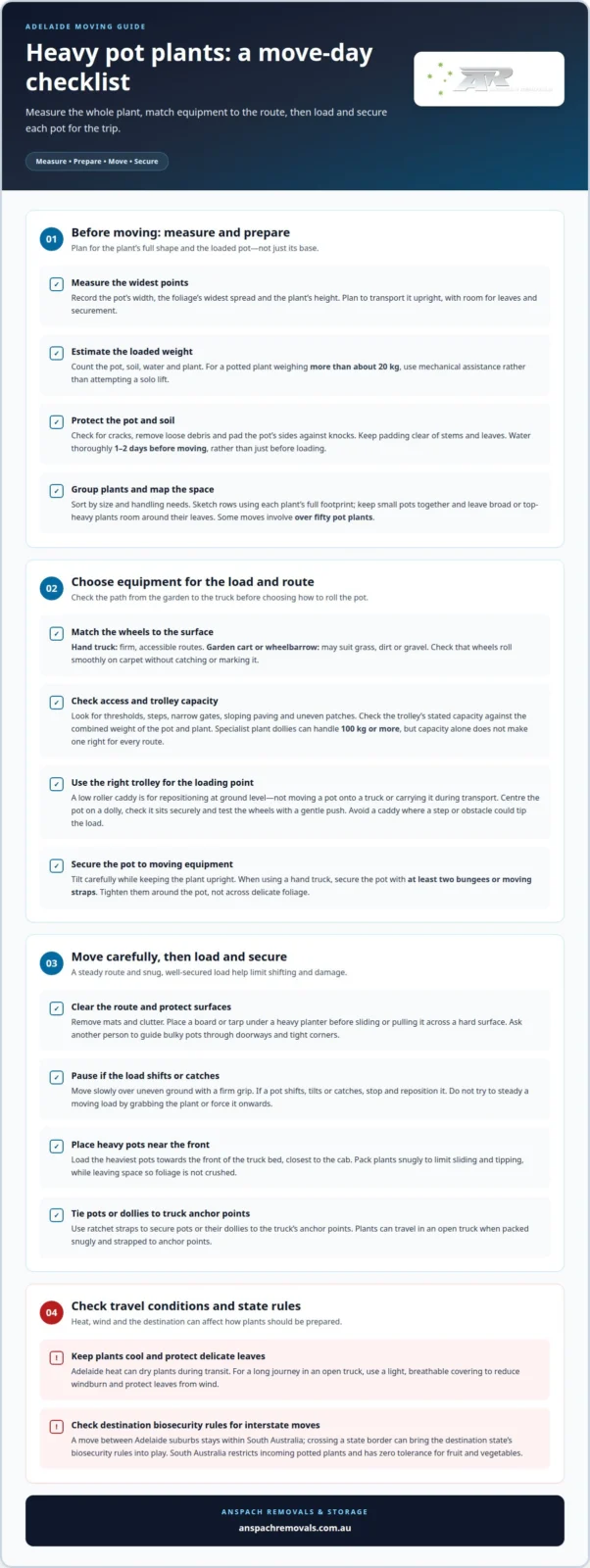
The truck space needed for heavy pot plants depends on each plant’s pot width, canopy spread and height. Measure the widest point and plan to transport each plant upright. If you’re working out how to move heavy pot plants in Adelaide, group pots close enough to limit shifting, while leaving room to protect delicate leaves.
It’s easy to underestimate the room a broad plant needs, even when its pot looks compact. Estimate the space required, choose equipment suited to the plant’s weight and the ground, and plan how to secure it for the trip.
Use a practical plan that covers measuring, loading and securing pots in place. With preparation, you can protect your plants and make their journey to your new Adelaide home more manageable.
Key Takeaways
- Measure each plant’s widest point and height to plan its place in the truck, not just the footprint of its pot.
- For pots too heavy to lift comfortably, choose moving equipment suited to both the load and the surface.
- Pad pots against knocks and secure them with at least two bungees or moving straps when using a hand truck.
- Load heavy pots near the front of the truck and secure them to anchor points to help limit shifting during the journey.
Padding and strapping pots to moving equipment
A move between Adelaide suburbs stays within South Australia, while crossing a state border can bring the destination state’s biosecurity rules into play. South Australia restricts incoming potted plants and has zero tolerance for fruit and vegetables, so check the destination’s rules before an interstate move. Adelaide heat can dry plants during transit: keep them cool and protect delicate leaves from wind on long trips in an open truck.
- Prepare each pot. Inspect the pot for cracks, remove loose debris, and wrap the sides with padding to reduce knocks against equipment or neighbouring plants. Keep padding clear of stems and leaves. Water thoroughly 1-2 days before moving, rather than just before loading, so the soil is not freshly saturated and heavy.
- Choose a stable way to roll it. Use a garden cart, hand truck or wheelbarrow for a pot that is too large to lift or roll manually. Tilt the pot carefully onto the equipment, keeping the plant upright, then secure it with at least two bungees or moving straps. Tighten straps around the pot, not across delicate foliage.
- Plan for soft ground. A hand truck can move a large potted plant across grass, dirt, gravel or carpet. Move slowly over uneven patches and keep a firm grip on the handle. If the pot shifts, stop and reposition it before continuing, rather than trying to steady a moving load by grabbing the plant.
- Group plants in manageable batches. Some moves involve over fifty pot plants, so sort them by size and handling needs before loading. Keep small pots together and give broad or top-heavy plants room around their leaves. For a long journey in an open truck, use a light, breathable covering to reduce windburn, and keep the plants cool.
Choosing equipment based on pot weight and terrain
- Estimate the loaded weight first. Include the pot, soil, water and plant, as a large ceramic planter can weigh far more than it looks. For potted plants weighing more than about 20 kg, use mechanical assistance instead of attempting a solo lift. A practical plan for how to move heavy pot plants in Adelaide starts with grouping containers by approximate weight and size.
- Match equipment to the route. Check the path from the garden to the truck, including thresholds, steps, narrow gates and sloping paving. A hand truck suits firm, accessible routes; a garden cart or wheelbarrow may work better across grass, dirt or gravel. On carpet, consider whether the wheels roll smoothly without catching or marking the surface.
- Choose a trolley for the load. Check its stated capacity against the combined weight of the pot and plant. Specialist plant dollies can handle loads of 100 kg or more, but that capacity alone doesn’t make one suitable for every route. A low roller caddy suits ground-level repositioning, not moving a pot onto or in a truck.
- Share useful details when arranging the move. Describe the heaviest pots, approximate weights, plant count and any stairs or uneven paths. Mention narrow access, long carries and whether the relocation stays in Adelaide or crosses state borders. These details help the moving team plan labour, equipment and truck space around the actual route. For guidance on how to move heavy pot plants in Adelaide as part of a household relocation, discuss your moving arrangements.
How much space in the truck will the plants take up?
Estimate truck space by measuring each pot’s widest point and the plant’s canopy, then plan to load plants upright. Allow room for leaves and securement. The pot’s footprint alone won’t show how much space a bulky plant needs.
- Measure the full footprint. Record the width of each pot and the widest spread of its foliage. For example, a compact pot with broad branches may need more room than its base suggests. Group plants by similar size, then sketch rows on paper so you can see how their combined footprints fit the truck bed.
- Protect the floor during movement. Place a board or tarp under a heavy planter before sliding or pulling it across a hard surface. Moving a pot directly can damage the floor, the planter or both, while awkward handling can cause injury. If lifting is necessary, bend your knees, keep your back straight and lift steadily with your legs.
- Get help with bulky loads. Ask another person to guide a large pot through doorways and around tight corners, while the person moving it controls the load. Clear the route first, including mats and clutter that could catch a pot or trolley. Stop and reposition if the planter tilts or catches; forcing it onwards can damage the pot or surface.
- Load and secure pots for transport. Place the heaviest pots towards the front of the truck bed, closest to the cab. Pack plants snugly together to limit sliding and tipping, but leave space so foliage isn’t crushed. Use ratchet straps to secure pots or their dollies to truck anchor points. Plants can travel in an open truck when packed snugly and strapped to anchor points.
Plant dollies, roller caddies, and hand trucks
Match the equipment to the pot, route and loading point. A trolley that works in the garden may not be suitable for the journey to the truck.
-
Compare plant dollies and roller caddies
Choose a plant dolly when the pot needs a stable base to move across a suitable surface. Check that its platform supports the pot’s base and its wheels can handle the route. A roller caddy is for repositioning at ground level, not for carrying a plant onto a truck or during transport.
Before moving, centre the pot on the dolly and check that it sits securely. Test the wheels with a gentle push, then guide the plant slowly around corners. Don’t use a caddy if the route includes a step or another obstacle that could tip the load.
-
Consider hand trucks and equipment hire or purchase
Use a hand truck when the pot can be tilted safely onto its base plate and the route allows controlled movement. Check the truck’s load rating against the combined weight of the pot, soil and plant. A narrow path, uneven paving or tight turn may make a hand truck difficult to control.
In Adelaide, equipment hire outlets and retailers that sell garden or moving equipment are places to look for hire or purchase options. Costs depend on equipment type, capacity and hire period, so compare these details rather than choosing by price alone. Check that the trolley suits the pot and route before arranging it.
For several heavy plants, map the route and equipment needs before moving day. A hand truck needs room to tilt and turn, while a dolly needs a smooth path. If you’re organising the wider move, get your moving plans organised alongside the equipment plan.
Anspach Removals & Storage
Anspach Removals & Storage can help plan your household move around bulky pots, plant space and the route to your new home. For an Adelaide relocation, Local Moves suits a move within the city; Country Moves and Interstate Moves cover relocations beyond Adelaide. Office & Commercial Relocations can help when plants are part of a workplace move.
When discussing your move, include the number and approximate size of the plants, along with any narrow access or steps. These details help shape the wider plan alongside your furniture and other household items. If the plants can’t go straight to the new property, consider arranging storage with Hendon’s Self Storage.
Contact Anspach Removals & Storage to discuss your move and how your pot plants fit into the plan.
Make the move easier on moving day
A well-planned move doesn’t finish when the truck reaches your new home. Place each plant somewhere with similar light exposure to its previous position, then watch for wilting or yellowing over the next few weeks. This helps you notice how each plant is adjusting while you unpack and arrange your new space.
Planning how to move heavy pot plants in Adelaide means fitting them into the wider move, rather than treating them as an afterthought. Share your plant list and any access details when organising the relocation, so the plan can account for your household’s needs. This helps you focus on settling in, rather than making last-minute decisions about where a large planter can go.
For help coordinating your move, contact Anspach Removals & Storage. Your plants can be part of a considered start in your new home.
Frequently Asked Questions
Should I water my pot plants before moving day?
Yes. Water thoroughly 1-2 days before moving, rather than immediately before loading. This gives excess water time to drain and avoids adding unnecessary water weight during lifting and transport. For example, check that a large planter’s saucer isn’t holding pooled water before it’s moved. If a plant has specific watering needs, keep its usual care routine in mind alongside the move.
Transport options: DIY or a carrier?
DIY can suit a small group of manageable pots when the route is clear and you have suitable equipment and help. A removalist may be more practical for heavy planters, several plants, difficult access or a longer journey from Adelaide. Consider who will handle loading, securing and unloading, and whether the schedule allows enough time to transport plants carefully.
What equipment is best for moving heavy potted plants, such as plant dollies, hand trucks, or lifting straps?
Choose equipment to suit the pot’s base and the route. A plant dolly supports a pot while it rolls over a suitable level surface; a hand truck helps move a pot along a route where it can be tilted safely. Straps can secure a load to equipment, but they aren’t a substitute for a stable platform or controlled handling.
How much weight can common plant dollies and hand trucks carry?
Specialised plant dollies can handle loads of 100 kg or more, while hand-truck capacity varies by model. Read the equipment’s load rating and compare it with the combined weight of the plant, pot, soil and water. For example, a heavy ceramic pot with damp soil can weigh more than the empty planter suggests, so don’t estimate from pot size alone.
How do I prepare and secure a large potted plant for moving?
Remove loose debris, check the pot for cracks and keep the plant upright while handling it. Centre the planter on a suitable trolley, then secure the pot so it can’t shift independently. In the truck, secure the pot or its dolly to an anchor point. Leave enough room around broad foliage to prevent neighbouring items from crushing the leaves during the journey.
When should I prune or water a heavy potted plant before moving it?
Inspect and prune plants during advance move preparation, rather than leaving trimming until loading. This allows you to remove damaged or overhanging growth without rushing on moving day. Water thoroughly 1-2 days before the move so excess moisture can drain. Avoid heavy pruning simply to make a plant fit; protect its shape and plan transport space around its canopy.