
A written, itemised quote and a clear contract are your first protections against removalist scams and surprise charges. Removalist companies in Australia aren’t required by law to insure your belongings during a move, so ask what cover applies and read the terms before agreeing. Knowing how to deal with difficult removalists also means keeping records and raising problems in writing.
A stressful move can make unexpected charges, poor communication or damaged belongings especially difficult to manage. If you’re wondering how to deal with difficult removalists, start by asking for clear answers about the agreed service, insurance and any extra costs.
This guide explains warning signs to look for before booking, how to handle disputes about costs or damage, and the consumer guarantees that apply to removalist services. It also covers the steps for making a complaint to NSW Fair Trading if you can’t resolve the issue directly.
Key Takeaways
- Read the service details and payment terms before you agree, and keep a copy of the contract and messages.
- Keep valuables and important documents with you, and look for warning signs such as unclear terms or unsupported claims.
- Document damage or service problems promptly, then give the removalist a clear chance to respond.
- If direct discussions don’t resolve the issue, prepare a concise complaint with supporting correspondence for NSW Fair Trading.
Asking about insurance, damage and extra charges
Before the truck is loaded, understand what insurance applies, how damage concerns are handled and what the quote includes. Ask for clear answers in writing and keep them with your booking documents.
Damage concerns
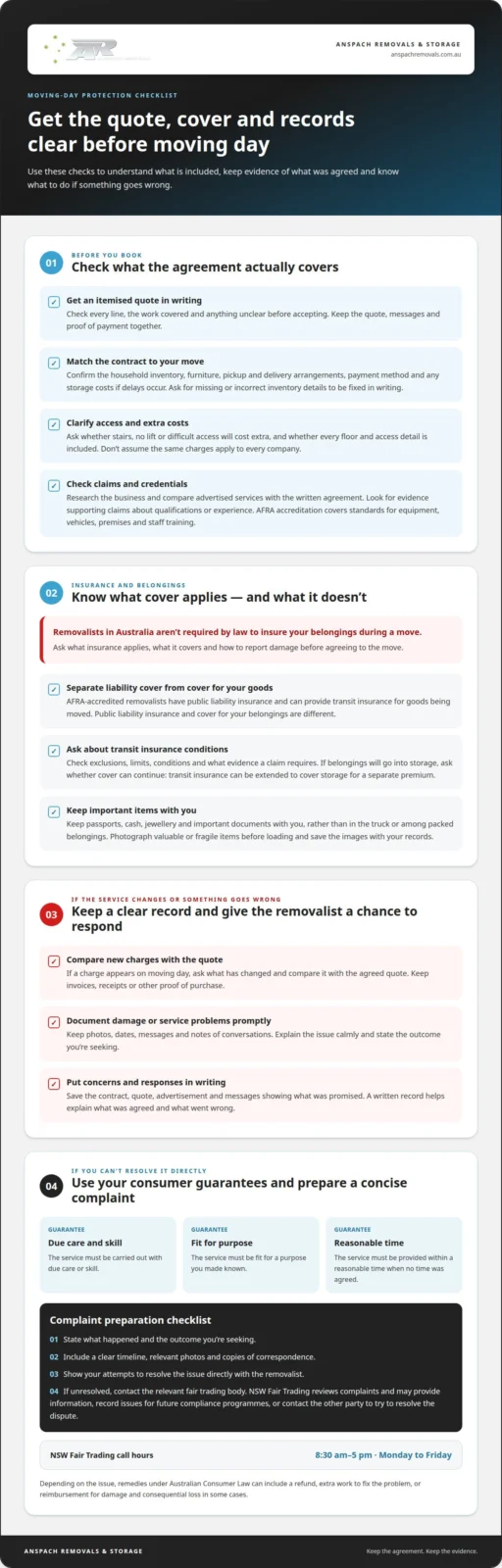
Damage concerns involve who is responsible if belongings are lost or harmed during a move. Before booking, ask what insurance applies, what it covers and how to report damage. Removalist companies in Australia aren’t required by law to insure customers’ property during a move. AFRA-accredited removalists have public liability insurance and can provide transit insurance for goods being moved. Photograph valuable or fragile items before loading and keep the images with your records.
Ask whether transit insurance has exclusions, limits or conditions, and what evidence a claim requires. If your belongings will go into storage, ask whether cover can continue there. Transit insurance can be extended to cover storage, with a separate premium. Public liability insurance and cover for your belongings are different, so clarify which applies.
Extra charges
Extra charges are costs added to the quoted amount for particular work or access conditions. Ask whether carrying items up apartment stairs without a lift costs extra and whether the quote accounts for every floor and access detail. Some removal companies don’t charge extra for stairs, so get the answer in writing rather than assuming it applies to every move. Clarify any charge for difficult access before accepting the quote.
Request a written, itemised quote before hiring. Check each line, including the work covered, and ask about anything unclear before accepting. If the movers identify a new charge on moving day, compare it with the quote and ask what has changed. Keep messages, the quote and proof of payment together. Australian consumers are entitled to proof of purchase, such as an invoice, receipt or handwritten receipt.
Australian Consumer Law includes automatic consumer guarantees for removalist services. If a service fails to meet a guarantee, remedies can include a refund, extra work to fix the problem, or reimbursement for damage and consequential loss in some cases. Clear records help show what was agreed and what went wrong.
Avoiding removalist scams
Knowing how to deal with difficult removalists starts with researching the business and asking friends, family or colleagues for referrals. Compare advertised services with the written agreement before committing. The agreement should describe the furniture, pickup and delivery arrangements, payment method and any storage costs if delays occur. Keep a copy so you can compare the promised service with what happens on moving day.
AFRA accreditation is one practical point to investigate. AFRA-accredited removalists must meet standards covering equipment, vehicles, premises and staff training. Accreditation doesn’t replace reading the contract, but it gives you specific details to consider when assessing a company’s stated credentials. If an advertisement claims particular qualifications or experience, look for clear supporting information rather than relying on broad promises.
Check that the contract matches your move. It should set out the service, household inventory, pickup and delivery details, payment method and storage costs if delays occur. Read every part before signing, especially the inventory. If a large cabinet or several boxes are missing from the list, for example, ask for the written details to be corrected before the move proceeds. A complete agreement gives both sides a shared record.
A sound approach to how to deal with difficult removalists includes keeping evidence of what was promised. In Australia, removalist services must be advertised truthfully and accurately, and claims about qualifications or experience should be supported. Save the advertisement and messages describing the service. If the offer changes later, those records help you explain your concern without relying on memory during a stressful move.
Keep passports, cash, jewellery and important documents with you, not in the truck or among packed belongings. Under Australian Consumer Law, removalist services must be provided with due care or skill, be fit for a specified purpose, and be provided within a reasonable time when no time is set. These guarantees apply alongside the written terms, so preserve your contract and messages if the service falls short.
Making a complaint to NSW Fair Trading
If you can’t resolve the problem through discussion with the removalist, you can make a complaint to the relevant fair trading body. State the issue and the outcome you’re seeking clearly.
Consumer rights under Australian law
Australian Consumer Law gives you automatic consumer guarantees when you hire removalists. The service must be carried out with due care and skill, be fit for a purpose you made known, and be provided within a reasonable time if no time was agreed. These rights matter if the move is delayed, handled poorly or fails to meet an agreed purpose.
To address a dispute during the move, explain the problem calmly and state the outcome you’re seeking. Keep a careful record of conversations, dates, photos and messages. If you can’t settle the issue directly, provide the relevant fair trading body with details of what happened and copies of correspondence showing your attempts to resolve it.
NSW Fair Trading can be called between 8:30am and 5pm, Monday to Friday. It reviews complaints to determine an appropriate resolution. This may include providing information, recording issues for future compliance programs, or contacting the other party to try to resolve the dispute. A clear timeline helps show where communication stopped and what remains unresolved.
Escalating a removalist dispute
Escalation means seeking a formal path when direct discussions and fair trading assistance haven’t resolved the dispute. For a complaint about the moving service, contact the fair trading body in your state or territory. AFCA handles complaints about financial firms and services, not removalist work itself. A tribunal may be an option for a formal consumer dispute, while a lawyer can explain legal options relevant to your circumstances.
Before taking another step, organise the contract, itemised quote, receipts, photographs and messages into one file. Write a short summary of the agreed service, what went wrong, your attempts to resolve it and the outcome you want. This helps a tribunal or lawyer understand the separate issues and shared facts without relying on memory during a stressful dispute.
Minor and major service problems
Australian Consumer Law distinguishes service problems that can be fixed from major failures. The difference affects whether the removalist gets an opportunity to put things right or you can end the contract.
Minor service problems
A minor problem is a removalist-service issue that can be fixed. The business must have an opportunity to fix it before you seek another remedy, and it can choose how to do so. For example, if an agreed task was missed but can still be completed, describe the omission and ask for it to be corrected.
Keep your request specific and in writing. Note what happened, when it occurred and what fix would address it. If the repair takes too long, you can arrange for someone else to fix the problem and ask the business to pay reasonable costs. You can also cancel the service and seek a refund. Keep receipts and messages showing the delay and your response.
Major service problems
A major problem includes a failure that would have stopped someone buying the service, makes it substantially unfit for purpose and can’t be fixed within a reasonable timeframe, creates an unsafe situation, or fails to meet a specific purpose or result you requested. These criteria distinguish a serious failure from a smaller issue, such as a task that can still be completed.
For a major problem, you can terminate the services contract and request a full refund, or seek reimbursement for the difference in value. Record the facts carefully. For example, note whether fragile belongings were damaged in transit or whether an unsafe handling issue prevented the agreed work. Describe the impact without overstating it, and keep relevant photos and correspondence together.
For fragile items, clear packing can help reduce handling risks during a move. If you’re planning a move and want support preparing belongings, explore packing services as part of your arrangements.
Anspach Removals & Storage: Local Moves
Anspach Removals provides Local Moves for households planning a move in Adelaide and surrounding areas. Its services also include Country Moves, Interstate Moves and Office & Commercial Relocations, with packing assistance available for moves that need it.
Choose the service that matches your move: a household relocation, a move across South Australia, an interstate move, or a workplace relocation. Sharing details about your belongings, access and destination helps shape practical arrangements. For a local household move in Adelaide, Local Moves are the relevant option; for a business relocation, Office & Commercial Relocations address that different need.
Contact Anspach Removals & Storage to discuss your upcoming move.
Plan your next move with confidence
A move marks a change in more than address. It can reshape routines, access needs and the way you want to settle into your next home. Give yourself space to choose the kind of support that fits this next chapter, rather than letting moving-day pressure make the decision for you.
Knowing how to deal with difficult removalists can help you approach future moves with a steadier plan. Anspach Removals & Storage offers Local Moves, Country Moves and Interstate Moves, with options suited to different journeys and destinations. Consider which type matches your plans, whether you’re moving nearby, across South Australia or between states.
When you’re ready to discuss your move, contact Anspach Removals & Storage. A considered start can help you move forward with greater confidence.
Frequently Asked Questions
How do I avoid being scammed?
Protect yourself by checking that the written agreement matches the actual move before handing over belongings or payment. If the booking describes a two-bedroom home but leaves out a storage area, for example, ask for an accurate inventory and scope. Keep copies of advertisements, messages and the signed agreement. If someone changes important terms verbally, ask for the change in writing before proceeding.
What is important when choosing a moving company?
Choose a company whose documented services fit your move and whose claims you can assess. Ask trusted people for referrals, then compare the proposed work with your needs, such as moving heavy furniture or coordinating an office relocation. AFRA accreditation is another detail to consider because accredited removalists must meet standards for equipment, vehicles, premises and staff training. Look for clear, consistent information.
What makes a move go wrong?
A move can run into trouble when the agreed plan doesn’t match the property or the items being moved. An oversized couch may not fit through a narrow entry, for example, or a building may restrict lift access during the booked period. Share details about awkward furniture, stairs and building rules early. A clear plan helps the moving team prepare for access challenges before the truck arrives.
What questions should I ask removalist companies when booking?
Ask what the service includes, which items are listed in the inventory, and how pickup and delivery will be managed. Clarify payment arrangements, how changes to the move are handled, and whether storage costs apply if delays occur. Describe fragile belongings or furniture requiring special handling clearly. These questions help reveal gaps between your expectations and the written booking before moving day.
What should I do if removalists arrive late or fail to show up in Australia?
Contact the company promptly using the booking details and ask for an updated arrival time or a clear explanation. Keep a record of calls and messages, note how the delay affects access or key arrangements, and save receipts for related expenses. If the movers don’t arrive, request a written account of the next steps. Australian Consumer Law requires services to be provided within a reasonable time when no timeframe was agreed.
How do I check whether an Australian removalist is licensed, insured, and reputable?
Ask what licences, if any, are relevant to the work and verify any stated licence with the issuing authority. Removalist companies aren’t required by law to insure customers’ belongings during a move. AFRA-accredited removalists have public liability insurance and can provide transit insurance for goods being moved. To assess reputation, seek referrals and compare advertising claims with the written agreement and supporting details.