
Imagine it’s Monday morning in the Adelaide CBD; instead of a chaotic scramble for loading zone permits or frantic calls about disconnected servers, your team simply logs in and gets to work. It sounds like a dream, but for most local business owners, the reality of moving is a source of genuine anxiety. You’re likely worrying about the “gap” between leases, the safety of your expensive IT infrastructure, or how to keep staff morale high while boxes are piled to the ceiling. It’s a heavy burden to carry when you’re also trying to manage 2026 WHS regulation changes and rising ASIC fees.
We’ve built this office relocation checklist Adelaide to turn that logistical nightmare into a precision-engineered plan. Our goal is to ensure your transition is a “business as usual” event with zero data loss and total equipment safety. This guide provides a timeline-based strategy that covers everything from navigating the 15.5% CBD vacancy rate to managing the new two-metre WHS fall protection thresholds for your fit-out. You’ll finish with a clear, actionable roadmap that you can present to your directors with total confidence, knowing every detail of your move is under control.
Key Takeaways
- Understand why a 12-month lead time is essential for navigating South Australian lease “make-good” clauses and setting a precise relocation budget.
- Discover how to vet commercial movers to ensure they possess the specialised insurance and equipment necessary for protecting high-value assets.
- Utilise our comprehensive office relocation checklist Adelaide to manage IT migrations and stay ahead of the long lead times for local infrastructure transfers.
- Master the logistics of the Adelaide CBD by securing Council parking permits and briefing building managers on after-hours security protocols.
- Implement post-move optimisation strategies, such as staff “Welcome Packs,” to maintain morale and ensure a seamless “business as usual” transition.
Phase 1: The Strategic Foundation (6–12 Months Before Move)
A successful move starts long before the first box is taped shut. If you’re building an office relocation checklist Adelaide business owners can actually rely on, the work begins at least six to twelve months out. This isn’t just about booking a truck. It’s about dissecting your current lease and identifying “make-good” obligations. In South Australia, these clauses can be surprisingly specific. They might require you to return the space to its original shell or repaint walls in specific colours. Missing these details can lead to expensive bond disputes that eat into your new fit-out budget.
You also need to define your “Restart Priority List.” Don’t assume every department needs to be online at the same time. Ask yourself: which team must be operational within sixty minutes of the doors opening? Usually, it’s IT or customer support. Mapping this out now ensures your logistics provider knows exactly which crates to offload first to maintain your office relocation checklist Adelaide timeline.
The Relocation Committee: Who Needs a Seat at the Table?
Don’t let the move become a siloed project. You need IT, HR, and Operations working in sync from day one. IT ensures the server migration is planned, often with the support of Business Analysis & Solutions to align ICT infrastructure with long-term digital strategy. HR manages the human element, addressing staff concerns about new commutes. We recommend assigning “Floor Wardens” for different zones of your current office to oversee packing progress. Setting up a dedicated channel on Slack or Microsoft Teams keeps communication transparent and prevents vital details from getting lost.
Budgeting for the “Hidden” Costs of Moving in Adelaide
Your budget must extend beyond the removalist quote. Factor in professional end-of-lease cleaning and minor repairs to secure your bond. Weigh the cost of new furniture against relocating old inventory. For heavy items like fireproof safes, you’ll need specialised furniture removalists Adelaide businesses trust. Professional Relocation service experts suggest a 10% contingency. This is crucial as 2026 WHS changes for fall risks over two metres may increase fit-out contractor costs.
Phase 2: Vetting Office Removal Companies in Adelaide
Choosing the right removalist isn’t just about finding the lowest hourly rate. It’s about finding a partner who understands that every hour your staff isn’t working is lost revenue. When you’re refining your office relocation checklist Adelaide, vetting your potential partners should be your top priority. A residential mover might be great at wrapping a sofa, but do they have the precision to handle a server rack or a multi-floor layout? You need a team with a proven local track record and the right accreditation, such as AFRA, to ensure they meet national standards for equipment and training.
Don’t settle for a quote over the phone. A professional commercial mover will insist on an on-site or detailed virtual inspection. This allows them to identify logistical hurdles like narrow lift access or strict Adelaide CBD loading zone restrictions before the clock starts ticking on move day. It’s this level of foresight that prevents “surprise” costs from blowing your budget.
Commercial vs. Residential Removalists: What is the Difference?
Office moves require specialised kit that you won’t find in a standard residential truck. Think computer trolleys, library carts for heavy files, and anti-static wrapping for delicate electronics. Beyond the tools, the insurance profile is vastly different. You need a provider whose transit insurance covers business-grade assets and high-value IT infrastructure. Understanding the full scope of these differences is essential; our guide on commercial removals vs residential moves breaks down exactly why treating an office relocation like a house move can lead to costly mistakes. Availability is also key; most Adelaide businesses prefer moving on Friday nights or over the weekend to ensure they’re back online by Monday morning.
Questions to Ask Before You Sign the Contract
Before you commit, ask for a clear breakdown of their project management process. While you’re busy notifying key agencies about your change of address, your mover should be providing a dedicated point of contact to handle the heavy lifting. If you’re still in the research phase, our office removalist selection guide offers more detail on what to look for.
Consider these specific questions during your consultation:
- Do you provide a dedicated project manager for the move day?
- What is your process for handling sensitive server equipment and data?
- Can you provide secure storage Adelaide if the new site isn’t ready?
Having a clear plan for these scenarios is what separates a smooth transition from a chaotic one. If you’re looking for a partner who takes personal responsibility for your business continuity, we’re ready to help you plan every detail.
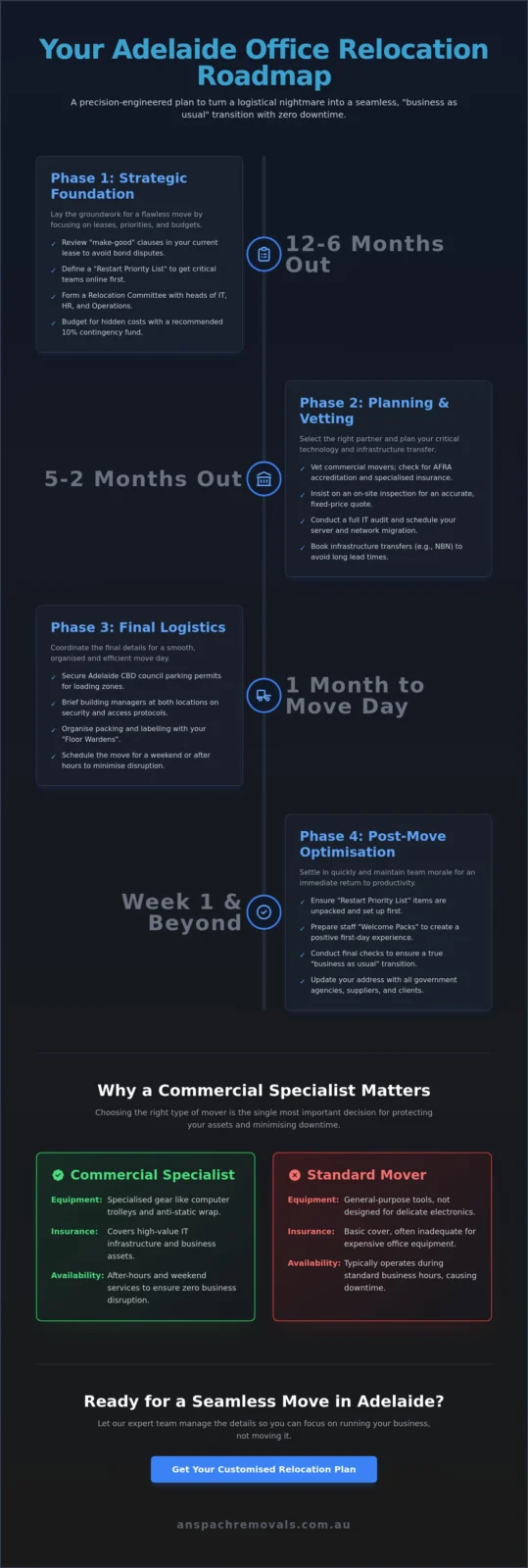
Phase 3: IT Audit and Infrastructure Migration (3–5 Months Out)
Data is the lifeblood of your operation. When you’re working through your office relocation checklist Adelaide, the IT audit is the moment where precision pays off. It’s not just about counting monitors; you need to decide what is being moved, what is being upgraded, and what is being retired. As noted by experts on relocating a company’s IT infrastructure, this phase is often the most complex part of the entire transition. The golden rule is simple: back up every byte of data to the cloud before a single server is unplugged. Don’t risk your business continuity on a hard drive that might not survive the transit vibrations.
Internet and phone line transfers in Adelaide can have longer lead times than you’d expect. We’ve seen businesses wait weeks for a fibre connection because they didn’t book early enough. Aim to have your ISP confirm the connection is live at the new site at least 48 hours before you arrive. This gives you a buffer to troubleshoot any unexpected hardware handshakes. While the new office is still a shell, plan your layout with a focus on power and data. It’s much cheaper to install extra ports while the space is empty than to call a technician back once the desks are in place.
The Digital Handover: Managing Connectivity
Liaise with your providers to ensure the NBN or private fibre is active well before move day. We suggest testing the new Wi-Fi mesh network while the office is empty. Without furniture or people to block signals, you can easily identify dead zones and adjust your router placement. This is also the time to organise the decommissioning and recommissioning of your server room, ensuring a professional handles the cable management and cooling requirements.
Decluttering and Disposal (The “Clean Slate” Policy)
Moving rubbish is the most expensive mistake an Adelaide business can make. Every crate of old cables or broken monitors costs you money in transport and physical space. Implement a “Clean Slate” policy; if it hasn’t been used in two years, it doesn’t cross the threshold of the new office. Organise e-waste recycling for old monitors and towers. This is also the perfect opportunity to commit to a paperless transition by digitising your archives before the first box is packed for your office relocation checklist Adelaide process.
Phase 4: The Final Countdown and Move Day Logistics
The final week is where your strategic foundation meets the pavement. Your office relocation checklist Adelaide should now pivot toward the street-level details that often catch businesses off guard. This isn’t just about moving boxes; it’s about managing a high-stakes logistics operation in a busy urban environment. Briefing building managers at both your old and new sites is essential. You need to confirm lift access times and ensure after-hours security is aware of the increased foot traffic. Without this coordination, your team might find themselves standing on the footpath with a truck full of desks and no way to get them to the fourth floor.
We use a “Crate and Label” system to remove the guesswork from move day. Every item, from the CEO’s monitor to the breakroom kettle, receives a colour-coded label corresponding to its exact location in the new office. During the load-out, we stage the truck to ensure “Priority One” items—the infrastructure you identified in Phase 1—are the first to be unloaded. This sequencing is what allows your IT team to start recommissioning servers while the rest of the furniture is still being positioned.
Navigating the Adelaide CBD: Access and Permits
If your move involves Waymouth, Grenfell, or King William Streets, you must account for strict Adelaide City Council “Commercial Vehicle” rules. Parking is at a premium, and you’ll likely need to apply for “On-Street Activity” permits if a large truck needs to occupy a lane or a metered zone. Don’t forget to check height clearances for underground loading docks. Sites like Rundle Place or the GPO Exchange have specific limits that can stop a standard removal truck in its tracks. Knowing these dimensions beforehand prevents costly delays and ensures a smooth arrival.
Move Day: The Command Centre
On the day, your Relocation Committee should function as a central Command Centre. We recommend setting up a dedicated “Help Desk” at the new location immediately. This gives staff a single point of contact for troubleshooting minor snags, like missing cables or desk height adjustments. Ensure your “First Day Essentials” box—containing chargers, basic tools, keys, and coffee—is clearly marked and easily accessible. For a minute-by-minute breakdown of how to manage these timings, refer to our office relocation Adelaide template.
Managing the fine details of a CBD move requires local knowledge and a calm head under pressure. If you want to ensure your business transition is handled with total precision, download our full template or reach out to our team to discuss your specific logistics needs.
Phase 5: Post-Move Optimisation and The Anspach Way
The final truck has departed, and the keys to the old site have been handed back, but the transition isn’t truly complete until your team feels at home. This final stage of your office relocation checklist Adelaide is about refinement and celebration. Start by conducting a thorough post-move walk-through. This isn’t just a quick glance; it’s a systematic check to identify any snags, minor scuffs, or items that aren’t exactly where they belong. Addressing these details in the first 24 hours prevents small frustrations from becoming permanent distractions for your staff.
Settling In: The First 48 Hours
Your “Restart Priority List” from Phase 1 should guide your testing. Ensure every workstation is live and printers are talking to the network before the first client call arrives. You also need to tackle the administrative side of the relocation. As of July 2026, the ASIC fee for renewing a business name has risen to $47 for one year. While you’re updating your address on your Google Business Profile and website, ensure your ASIC and Australian Business Register details are also current to avoid compliance headaches. Finally, hold a “Post-Mortem” meeting with your Relocation Committee to officially close the project and document any lessons for future expansions.
The Local Advantage for Adelaide Businesses
Choosing a partner who understands the unique rhythm of South Australia makes a world of difference. We know the building quirks of the older CBD towers and the best times to navigate the arterial roads without getting stuck in peak-hour gridlock. When you work with local removalists Adelaide businesses trust, you’re not dealing with an interstate call centre. You’re dealing with a family-owned team that takes personal responsibility for your business continuity. We’re proud to support the SA economy and treat every office move as if it were our own. Once the last crate is collected and your space is optimised, you’ll see that a move managed with precision isn’t just a change of address; it’s a launchpad for your company’s next chapter.
Secure Your Business Continuity with a Precise Move
Moving your business is more than just a change of scenery; it’s a strategic leap that requires absolute precision. By following this office relocation checklist Adelaide, you’ve already taken the first step toward a transition that protects your data, your equipment, and your team’s morale. Success lies in the fine details, from auditing your IT infrastructure months in advance to navigating the specific loading dock clearances of the Adelaide CBD.
At Anspach Removals & Storage, we’ve been proudly South Australian owned and operated since 2002. We don’t just move desks; we provide expert commercial project management to ensure your business stays online throughout the process. Whether you need full-service packing or secure storage solutions, our family-run team takes personal responsibility for every crate. We understand the local quirks of our city because we’ve been part of this business community for over two decades.
Don’t let the logistics of relocation distract you from your core goals. Request a tailored Office Relocation Quote from Anspach Removals & Storage today. We’re ready to help you turn your next office move into a seamless new beginning.
Frequently Asked Questions
How far in advance should I book office removal companies in Adelaide?
You should aim to book your removalist at least three to six months in advance. This lead time is essential for securing your preferred dates, especially if you require a weekend move to minimise disruption. Early booking also allows for a detailed on-site inspection, which is a critical part of your office relocation checklist Adelaide planning to ensure an accurate, fixed quote.
Do we need to pack our own desks, or will the removalists do it?
We offer full-service packing solutions, so your team doesn’t have to manage the heavy lifting. While some businesses prefer to have staff pack their own personal desk items, our professional packers handle everything from sensitive files to shared office equipment. This ensures everything is packed to commercial standards using high-quality moving boxes, significantly reducing the risk of damage during transit.
What happens if our new office space isn’t ready on the move date?
If there is a delay with your new site, we can transition your items into our secure storage facilities. This “bridge” service is common in commercial moves where fit-outs or lease start dates don’t perfectly align. We manage the transport to the storage centre and then deliver everything to your new office once the site is ready for occupation, ensuring a seamless transition.
How do we manage IT equipment to prevent data loss during a move?
The most effective way to prevent data loss is to perform a full cloud backup before any hardware is disconnected. We recommend having your IT team decommission servers and delicate workstations personally. Once unplugged, we use anti-static wrapping and specialised computer trolleys to transport the equipment, ensuring it remains stable and protected from vibrations throughout the journey.
Is it better to move the office over the weekend or during business hours?
Weekend moves are almost always the superior choice for maintaining business continuity. Moving on a Friday night or Saturday allows your IT team to have the network live by Sunday afternoon, ensuring your staff can log in on Monday morning without missing a beat. While weekday moves are possible, they often result in significant operational downtime that can impact your bottom line.
Do we need special insurance for a commercial relocation in South Australia?
Yes, you must ensure your move is covered by comprehensive commercial transit insurance. While standard business policies cover some risks, a specific relocation policy protects high-value assets like server racks and specialised machinery. We always recommend checking that your chosen removalist has the appropriate AFRA accreditation and insurance levels to cover the full replacement value of your business assets.
How can we minimise business downtime during the move?
You can minimise downtime by implementing a “restart-first” strategy. This involves identifying which departments are critical for hour-one operations and ensuring their equipment is loaded last and unloaded first. By following a structured office relocation checklist Adelaide, you can coordinate the setup of your IT infrastructure while the rest of the furniture is still being positioned in the new space.
What are the specific parking permit requirements for moving in the Adelaide CBD?
Moving within the Adelaide CBD requires specific “On-Street Activity” permits from the Adelaide City Council. These are necessary if the removal truck needs to occupy a metered zone or a lane on busy thoroughfares like King William Street. You must also check height clearances for loading docks, as some city buildings have restrictive limits that require smaller, specialised vehicles for access.