
What if the biggest risk in an office move isn’t the distance between locations, but a task no one realised they owned? An office relocation project plan 2026 can bring staff, IT teams and building contacts onto the same page before moving day, helping protect the work your business needs to keep running.
It’s understandable to worry that a move will disrupt operations longer than expected. When responsibilities are unclear or technology isn’t ready at the new premises, even a well-intentioned plan can leave people waiting. Map the work early, assign an owner to each task and make dependencies visible.
This practical guide will help you build a usable plan with clear owners, milestones and checks for essential equipment and business operations. You’ll learn how to compare the effort of managing tasks in-house with professional moving support, including when packing or storage may be worth considering. From coordinating building access and IT readiness to planning furniture logistics, you’ll have a clearer way to decide what to handle internally and what to outsource, so your team can settle in with confidence.
Key Takeaways
- Define the move’s scope across sites, teams, furniture, equipment, records and operational dependencies before setting dates.
- Use the office relocation project plan 2026 to organise tasks into connected workstreams, with an owner, due date, dependency, status and escalation contact for each.
- Compare internal coordination, professional relocation support and a blended approach against staff time, control, coordination effort and disruption risk.
- Build an adaptable checklist by working backwards from confirmed move dates and provider availability, then include testing and a post-move review.
- Keep the plan current as details change, and use a consistent briefing checklist when requesting and comparing relocation proposals.
Office relocation project plan 2026: define the move before setting dates
An office relocation project plan is a working document that sets out what’s moving, who’s responsible and how the business will keep essential operations running during the transition. It coordinates people, timing, logistics and continuity, treating the move as a business project rather than simply a list of boxes to shift.
Before booking dates, agree why the business is moving and what success looks like. The project management principles of defining scope, time and resources offer a useful starting point. For an Adelaide business, the plan should cover the current and new sites, affected teams, work areas, shared facilities, furniture, office equipment and records. Identify operational dependencies too, such as systems, services or processes staff need to do their work.
Set the scope, outcomes and decision-makers
Name a project sponsor who can make senior decisions, a day-to-day coordinator who maintains the plan, and the people authorised to approve changes to scope, timing or priorities. Include representatives from each affected department, as well as the contacts responsible for IT, facilities and staff communication.
Set practical measures of success. These might include essential work areas and equipment being ready before staff arrive, agreed business-critical operations continuing with minimal interruption, and employees receiving clear updates at key stages. Specify what must be operational first and what can be completed later.
Record assumptions and constraints before committing
Separate confirmed details from assumptions. Record proposed and confirmed move dates, lease or handover dependencies, and decisions still awaiting approval. If a date depends on a landlord handover or site readiness, show that dependency in the plan rather than treating the date as settled.
For both premises, note access arrangements, loading areas, lift bookings, any building procedures that affect moving items, and the relevant building contacts. Confirm requirements directly with landlords or building managers. Ask qualified advisers to check lease or other specialist matters where needed, and don’t assume arrangements at the new site match those at the old one.
- Reason for moving: Record the business need the relocation is intended to meet.
- Scope: List the sites, teams, spaces, items and operational dependencies included.
- Decision-making: Identify the sponsor, coordinator and change approvers.
- Constraints: Track dates, access details and outstanding confirmations.
- Success measures: State how readiness, continuity and staff communication will be assessed.
With these foundations recorded, the office relocation project plan 2026 gives everyone a shared reference point. It also makes the next step clearer: group the work into connected workstreams and assign each task an owner.
Build the office relocation project plan around connected workstreams
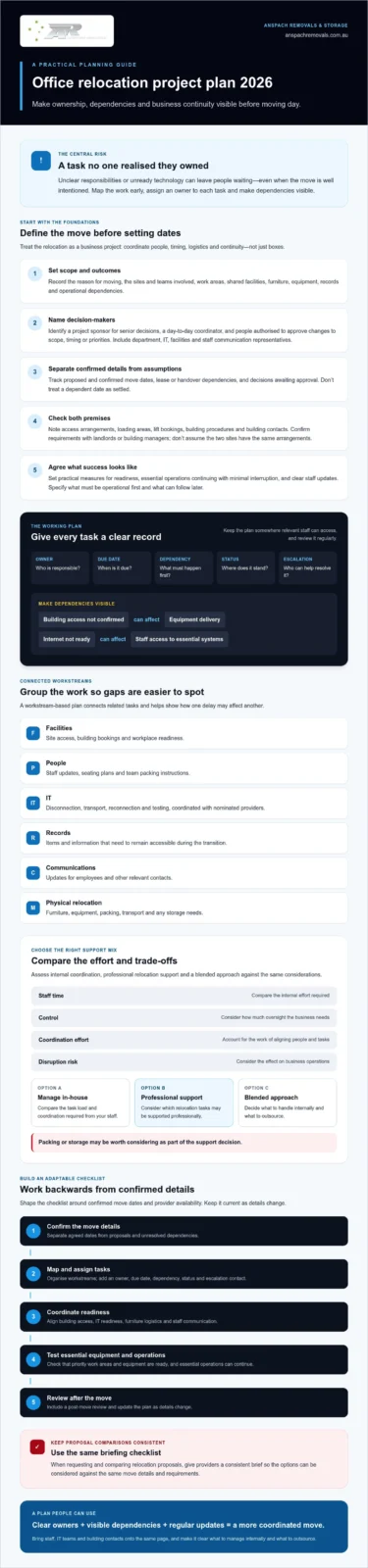
Once the move’s scope and decision-makers are clear, group the work into connected workstreams. This helps you spot how one delay can affect another. If building access isn’t confirmed, equipment may not reach the new office as planned. If internet access isn’t ready, staff may arrive but be unable to use essential systems.
For each task, record an owner, deadline, dependency, status and escalation contact. Keep the plan somewhere relevant staff can access, and review it regularly. The office relocation project plan 2026 should make dependencies visible, not just collect a long list of jobs.
- Facilities: Site access, building bookings and workplace readiness.
- People: Staff updates, seating plans and team packing instructions.
- IT: Disconnection, transport, reconnection and testing, coordinated with the business’s nominated providers.
- Records: Items and information that need to remain accessible during the transition.
- Communications: Updates for employees and other relevant contacts.
- Physical relocation: Furniture, equipment, packing, transport and any storage needs.
Coordinate staff, IT and workplace readiness
Assign someone to prepare the seating plan and share clear instructions with each team, including what to pack and how to label items. Confirm who is responsible for access arrangements at both sites. For IT, agree the sequence for disconnecting, moving, reconnecting and testing equipment with your nominated providers. Identify the systems, records or services that must stay available, and plan how staff can access them while the move is under way.
Manage furniture, packing and building logistics
Inventory furniture and office equipment, marking each item to move, dispose of, protect or store. Agree packing responsibilities and labelling conventions with staff, and note any handling requirements for items needing extra care. Check loading areas, access, parking and building-booking details with contacts at both premises. Confirm what professional relocation support covers before assigning tasks. Packing or storage may also be worth discussing if your move requires them.
| Task | Owner | Deadline | Dependency | Status | Notes |
|---|---|---|---|---|---|
| Confirm new-site access | Facilities lead | Agreed date | Building contact confirmation | Not started | Record booking details |
| Test internet and essential systems | IT lead | Before staff arrival | Connection and equipment ready | Not started | Escalate any service delay |
Use the same task structure across all workstreams, then update statuses and notes as decisions are confirmed. If you’re comparing help with furniture and office equipment logistics, you can explore Anspach office and commercial relocation support as one part of your wider plan.
Compare internal coordination with professional office relocation support
With the workstreams mapped, decide who will carry out and coordinate each part of the move. There’s no single model that suits every Adelaide business. A small move with staff available may be manageable internally, while a larger or more equipment-heavy relocation can place considerable demands on the team. The office relocation project plan 2026 helps you compare the real workload, not just the visible moving tasks.
Use this comparison as a starting point, then allocate responsibilities according to the move’s size, complexity and your team’s capacity.
| Approach | Control | Staff time and coordination | Equipment handling | Disruption considerations |
|---|---|---|---|---|
| Internal coordination | Direct control over task allocation and timing | Staff manage packing, access, communications and provider coordination alongside their usual work | Responsibility rests with the business and its assigned team | Work commitments or missed dependencies may affect readiness |
| Professional relocation support | The business retains oversight while agreeing the provider’s scope | Can reduce the internal load for the agreed physical relocation tasks | Discuss furniture and office equipment logistics with the provider | Confirm timing and responsibilities so the move aligns with operational needs |
| Blended approach | The business directs the project and allocates selected tasks externally | Internal staff manage business decisions; a provider supports agreed relocation work | Responsibilities are divided and documented in advance | Clear handovers help prevent gaps between internal and external tasks |
When an internal move lead may be enough
Internal coordination may suit a limited move if a capable lead has enough time and the business can assign clear owners across teams. Factor in the hours needed to organise packing, staff updates, site access and other service providers, not only the move itself. Before assigning specialist or building-related tasks internally, check whether they require qualified advice or approval from the relevant building contact.
When professional movers can reduce coordination pressure
Professional support may be useful when furniture and equipment logistics would stretch staff capacity or compete with essential work. Ask each provider to set out the proposed scope, timing, responsibilities and exclusions in writing. Compare like with like: check which tasks are included, what your team must prepare, and how any packing or storage needs are handled. Don’t judge proposals on headline price alone. First confirm that each covers the same requirements.
If you’re weighing local provider options, the office removalists Adelaide guide can help inform your broader comparison. Keep the business in the lead and choose the support model that fits the work ahead and the capacity you can realistically commit.
Turn the plan into a 2026 office relocation timeline and checklist
A useful timeline follows the order of decisions, not an arbitrary number of weeks. Start with the confirmed move date, then work backwards after checking site access, operational needs and provider schedules. The office relocation project plan 2026 should show which milestones depend on others, so a change to one date prompts a review of the tasks that follow.
Work backwards from the move date
Set milestone dates only when the relevant details are confirmed. For example, complete the inventory before finalising what needs to move, and confirm destination access before scheduling delivery. Allow contingency time for unresolved handover, access or equipment issues. If the dates for leaving one site and entering the next don’t align, consider whether temporary storage could bridge the gap; see this secure storage Adelaide guide.
Use decision gates to avoid moving ahead on assumptions. Confirm building access, inventory completion, IT readiness and destination readiness before approving the next dependent stage. If a gate isn’t met, record the issue, its owner and the next decision point.
Use move-day and first-day readiness checks
Before the move, confirm contact lists, arrival instructions, access arrangements and escalation routes with everyone involved. On the first working day, check priority work areas, connectivity and essential equipment before staff resume normal work. Log unresolved issues with an owner and next action rather than relying on informal follow-up.
Use this checklist as a final sign-off, adding a named approver for each item:
- Scope and inventory: Items and work areas accounted for. Approval: project coordinator.
- Building access: Arrangements confirmed at both sites. Approval: facilities lead.
- IT readiness: Essential connectivity and equipment tested. Approval: IT lead.
- Destination readiness: Priority spaces are ready for staff. Approval: workplace lead.
- Staff communication: Arrival instructions and key contacts shared. Approval: people or communications lead.
- Move completion: Outstanding issues have owners and next steps. Approval: project sponsor.
Review the checklist whenever dates, scope or dependencies change. For support with the physical relocation workstream, explore Anspach’s office and commercial relocation support and confirm the proposed scope against your plan.
Put the office relocation project plan into action with the right support
Your office relocation project plan 2026 should stay live through to completion. Review it whenever dates, scope or dependencies change, then update owners and next steps so everyone is working from the same version. A plan is useful only if it reflects the decisions the business has actually made.
Brief providers with comparable information
Give each provider the same clear brief so you can compare proposals against your actual requirements. Include the move locations, available access details, inventory scope and known timing constraints. Ask providers to set out their proposed responsibilities, assumptions, exclusions and any coordination they’ll need from your team. Confirm service details directly instead of assuming an item or task is included.
A simple briefing checklist can help:
- Locations: Provide the origin and destination details, plus confirmed access information for each site.
- Inventory: Describe the furniture and office equipment in scope, and identify anything requiring special discussion.
- Timing: Share confirmed dates and flag any handover or access details still awaiting confirmation.
- Responsibilities: Clarify what your staff will manage and what you’re asking the provider to handle.
- Optional requirements: Raise packing or storage if either may suit the confirmed move arrangements.
- Proposal details: Ask for scope, assumptions, exclusions and coordination requirements in writing.
Compare responses on the same basis. If a proposal covers different tasks or relies on different assumptions, ask questions before treating it as a like-for-like option.
Keep ownership clear through completion
Nominate one business contact to coordinate decisions and communicate approved changes to the provider and internal teams. That person doesn’t need to complete every task, but should know who owns outstanding work and where decisions are recorded. Before closing the move, seek sign-off from relevant department and site owners, and confirm unresolved issues have a named owner and next action.
After staff return, review what worked and where handovers or timing could be improved. Record those lessons while they’re fresh, ready for the next workplace change.
Anspach Removals & Storage is a South Australian-owned family business providing office and commercial relocations, with packing and storage available to discuss where they fit your requirements. If you’re ready to talk through the relocation workstream, talk to Anspach about your office relocation. Share your move details and current plan, then confirm the proposed scope directly.
Set your office move up for a confident start
A well-managed relocation starts with clear ownership and a shared view of what needs to happen. Your office relocation project plan 2026 should connect the move’s scope, people, timing and logistics, then stay current as decisions change.
Keep the focus on two essentials: protect the business operations that need to continue, and make responsibilities visible across your team and any providers. Compare support proposals against the same requirements, including agreed tasks, timing and exclusions, so you can choose an approach that fits your internal capacity.
For Adelaide businesses considering support with the physical move, Anspach Removals & Storage is a South Australian-owned and operated family business established in 2002. It provides office and commercial relocations, with packing and storage also available to discuss where they suit the move’s requirements.
Ready to discuss the relocation workstream for your business? Talk to Anspach about your office relocation. With a clear plan and suitable support in place, your team can move forward with greater confidence.
Frequently Asked Questions
What should an office relocation project plan include?
An office relocation project plan should set out the move’s scope, objectives, owners, workstreams, dates, dependencies, communications and readiness checks. The office relocation project plan 2026 should also track each task’s owner, deadline and status across staff, IT, facilities, records and physical relocation. For an Adelaide business, this gives teams a shared view of what’s ready, what may be at risk and who needs to act next.
How far in advance should you plan an office relocation?
Start planning as soon as a move is being considered, then set milestones around confirmed site dates, access arrangements, business needs and provider availability. There’s no single lead time that suits every Adelaide office. Work backwards from the intended move date, allow time for dependent tasks and flag unconfirmed details early. Check lease, building and other relevant deadlines directly with the responsible parties rather than relying on assumptions.
Who should manage an office relocation project?
Appoint a project sponsor with authority to make decisions and a coordinator to manage day-to-day tracking. Involve representatives for facilities, IT, people, communications and affected teams. Give every task, including work assigned to external providers, a named owner. The coordinator maintains the plan, raises delays and records decisions; the sponsor resolves competing priorities and approves changes to scope or timing. This keeps accountability clear across the Adelaide workplace.
How can a business minimise disruption during an office move?
Identify business-critical activities before deciding the move sequence, then plan around staff needs, site access, connectivity and essential equipment. Agree how teams will work during any transition period and share clear updates, instructions and contact details in one accessible place. Before normal operations resume, test priority systems and work areas at the new office. This helps uncover issues early and gives staff a clear route for reporting anything that still needs attention.
Should we use professional movers for an office relocation?
Choose based on the move’s size, equipment, access conditions and the time staff can realistically give to coordination. Compare the internal workload with professional support for the physical relocation, and consider a blended approach if that better fits your needs. Ask providers for written scopes, responsibilities and exclusions. For a fair comparison, share the same inventory, locations, access information and timing assumptions with each provider, whether your office is in central Adelaide or elsewhere in the city.
Can an office relocation plan include storage?
Yes, include storage as a possible workstream if the move dates don’t align, the new premises aren’t ready or some items won’t be needed straight away. List what may need storing, who will decide and when the items are expected to be required again. Discuss access and service details directly with providers before approving arrangements. For an Adelaide office move, make sure any storage plan fits the confirmed site dates and the wider relocation schedule.
What should happen on the first working day after an office move?
Confirm staff can access the new workplace and check priority work areas, essential equipment and connectivity before normal work resumes. Make sure employees know who to contact about problems and where to find updates. Keep a live issue list with an owner and next action for each outstanding task, then check in with affected teams. Test systems and areas rather than assuming they’re ready, and record any temporary arrangements staff need to follow.