
The truck is packed, but the keys aren’t ready, the weather’s turned or an essential document has vanished into a box. Moving day problems and solutions matter most when plans change and there’s little time to think. Start by identifying what affects safety, access and timing. Then update the people involved and adjust the next steps, rather than trying to fix everything at once.
A delay can affect property access, the move-in schedule and the safe handling of your belongings. Make decisions in order: deal with immediate hazards, confirm when access will be available, then protect items from weather and keep essentials close. For moves around Adelaide, allow for traffic and check that the truck has a suitable place to stop before loading or unloading begins.
This practical guide covers common moving-day setbacks, what to do when plans change and which belongings to set aside for easy access. It also includes fallback ideas, including storage when move-out and move-in times don’t align. Anspach Removals & Storage is a South Australian-owned family business offering local, country and interstate moves, as well as packing and storage services.
Key Takeaways
- When plans shift, confirm the problem, protect access, notify affected people and reset priorities in that order.
- Use these moving day problems and solutions to respond to delays, access changes and Adelaide traffic or parking constraints without rushing.
- Keep fragile, valuable and urgently needed belongings separate, and pause moving items if a path or load becomes unsafe.
- Keep key contacts, access details and essentials such as medication, chargers, documents and basic cleaning supplies together.
- Organised packing and professional moving support can reduce last-minute handling. Storage can help bridge a gap between move-out and move-in.
Moving day problems and solutions: what can go wrong?
A setback can feel bigger when the truck is waiting and the clock is ticking. A late key handover, blocked driveway or sudden change in the weather doesn’t automatically mean the move has failed. First deal with safety and protection, then work out how the change affects access and timing. A prompt, specific update helps everyone adjust to the same plan.
Which moving-day problems are most common?
Most disruptions fall into a few practical groups. Timing issues include a late arrival or key handover that doesn’t match the schedule. Access problems can mean a blocked driveway, unavailable loading space or a narrow street that makes it difficult to position the truck. Weather can expose boxes and furniture to rain, while hot conditions can make physical work more demanding. Packing problems include an open carton or an essential item buried out of reach. Communication gaps arise when household members, property contacts and removalists have different information.
Moving logistics have caused headaches for generations. The historical account of Moving Day (Boston) describes traffic jams, debris and the strain of many households moving at once. Today’s circumstances differ, but the lesson is familiar: congestion and coordination can affect a move. A practical response matters more than assuming every disruption signals failure.
What should you do first when plans change?
Pause and identify what has changed. Check whether anyone or anything is at immediate risk, then decide which issue needs attention first. Keep essential documents, medication, chargers and valuables with the household instead of packing them into general cartons. Send one clear update to everyone affected: explain what has changed, what happens next and when you’ll share another update. This reduces guesswork and helps people follow the same plan.
Use this quick order of action:
- Check: Confirm the delay, access change or other problem.
- Protect: Keep people clear of hazards and shield belongings from weather.
- Communicate: Give affected people one consistent update.
- Reprioritise: Adjust the immediate plan around access, keys and essential items.
This is the foundation of useful moving day problems and solutions: handle urgent risks first, then work through the logistics in a sensible order. You don’t have to fix every issue at once. A shared plan helps the move get back on track.
How to handle delays, access issues and Adelaide weather
A late truck, unavailable loading space or changed key time can unsettle the whole schedule. Start with the facts, make sure there is a safe route for people and belongings, then reset the plan with everyone who needs to know. For Adelaide moves, include likely traffic and the truck’s access to the property in your timing plan.
- 1. Confirm the issue. Get the latest arrival or access information from the person responsible. If settlement or key handover timing changes, share the update as soon as possible.
- 2. Protect access. Check that the truck can stop safely and that entrances, driveways and paths are clear. Don’t leave furniture or cartons in shared or public areas while waiting.
- 3. Update affected people. Give household members and the removal team one clear message about what has changed and the next step.
- 4. Reset priorities. Keep essentials accessible, adjust the order of tasks and decide whether loading, unloading or waiting makes the most sense.
If the removal truck or key handover is delayed
Confirm the revised timing before changing plans, such as when the household leaves or where belongings are kept. Keep medication, documents, valuables and immediate essentials in a small bag you can reach easily. If access is delayed, don’t leave possessions unattended in a foyer, on a footpath or in another shared space. Share the update early so everyone can adapt without adding avoidable confusion.
If weather or Adelaide access conditions change
Adelaide traffic, narrow streets and limited loading space can affect how easily a truck reaches a property. Check the route and current conditions, then review relevant council guidance for parking or loading restrictions. If rain is forecast, prepare a dry, clear route into each home. Use suitable coverings to protect floors and exposed belongings, while keeping walkways and exits unobstructed.
A simple contingency plan keeps key details together. Ready.gov Make a Plan offers general guidance on planning ahead and keeping important documents in mind. Apply that principle by keeping contact details, key arrangements and essentials easy to access. For an Adelaide move with changing access or timing, Anspach Removals & Storage’s professional moving support can help coordinate packing, loading and transport arrangements.
How to protect belongings when something goes wrong
If access changes or the loading area becomes crowded, slow the move down. A clear path matters more than keeping every item moving on schedule. Pause carrying furniture or cartons if a doorway, stairway or load looks unsafe. Clear trip hazards, keep children and pets away from active loading areas, and reassess the route before work resumes.
If a fragile item or doorway is at risk
Check the full path from the room to the truck, including corners, steps and doorways. Move loose objects out of the way. If a bulky item will not fit safely through a tight space, don’t force it through. Keep fragile pieces apart from general cartons, clearly labelled and easy to identify. For guidance on planning furniture moves, see our guide to professional furniture removalists in Adelaide.
Set aside a “keep close” area for items you’ll need straight away, such as medication, important documents, chargers and valuables. Keep these with the household rather than mixing them into cartons headed for the truck. Separating fragile, valuable and immediately needed belongings makes them easier to locate if plans change or unloading is delayed.
If something is missing or appears damaged
Check labelled cartons, your inventory and the designated essentials area before opening boxes at random. If an item is still missing, note where it was last seen and which cartons or areas you’ve checked. If you notice visible damage, record the item and its condition while the details are fresh. Keep the description factual and raise the concern through the appropriate communication channel for the move, so the next step is clear.
- Stop: Pause movement if a route or load seems unsafe.
- Separate: Keep fragile, valuable and essential items distinct from general cartons.
- Check: Look through labelled cartons and your inventory before unpacking everything.
- Record: Note what’s missing or damaged, where you found it and its visible condition.
These steps turn moving day problems and solutions into practical actions, not rushed guesses. Professional packing can help keep cartons organised and reduce last-minute handling. Anspach Removals & Storage also provides furniture removal services in Adelaide, helping plan the careful movement of bulky items through challenging access.
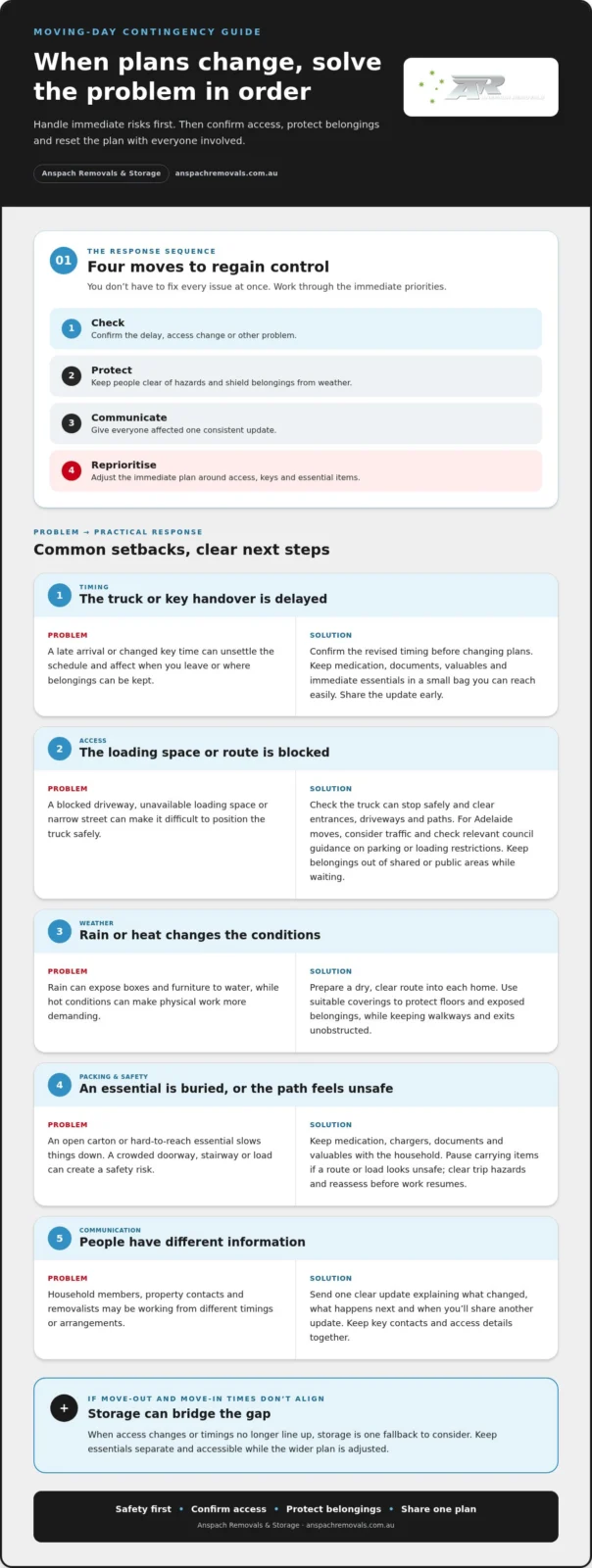
A moving-day contingency checklist you can use
A short written plan can save you searching through boxes or relying on memory when the schedule shifts. Keep this checklist on your phone or print it, and make sure another household member can access it too. The aim isn’t to plan for every possible snag. It’s to keep important details and next steps close at hand.
What belongs in a moving-day essentials kit?
Pack one clearly marked bag that stays with the household, not on the truck. Include daily medication, identification, keys, property documents, important contact details, phone chargers, toiletries and a change of clothes. Add water, snacks and basic cleaning supplies for the first few hours at the new place. If you’re moving with children or pets, set aside their immediate needs separately so they’re easy to reach.
- Contacts: Household members, removal team and relevant property contacts.
- Access: Key collection details, entry instructions and important access notes.
- Parking: Planned truck access and any council parking or loading information you’ve checked.
- Essentials: Medication, documents, valuables, water, snacks, chargers and cleaning basics.
How to make a backup plan for timing and storage
Write down who needs an update if the truck’s arrival, access or key handover changes. Decide which tasks can wait without affecting safety, property access or the protection of belongings. Unpacking non-essential cartons can wait. Keeping pathways clear and essentials accessible cannot. This distinction helps you focus on what matters instead of trying to preserve the original schedule at any cost.
Use this simple decision path if plans change:
- Delay: Confirm the revised timing, update affected people and keep the essentials kit with you.
- Access change: Check the new entry or loading arrangements before moving items.
- Weather shift: Protect exposed belongings and keep the route into the property clear and safe.
- Gap between homes: Consider secure storage in Adelaide if possession dates don’t line up.
When move-out and move-in dates differ, storage can provide a practical way to bridge the gap instead of rushing belongings into an unsuitable space. Keep the plan flexible and share changes promptly. A well-organised checklist turns moving day problems and solutions into manageable decisions, helping you keep essentials close and the next step clear.
For help coordinating your move and storage needs, explore Anspach Removals & Storage’s moving services.
When professional moving support can make a difficult day easier
When plans shift, a team managing the practical sequence can take pressure off the household. Anspach Removals & Storage provides moving services for households and businesses across Adelaide, regional South Australia and interstate. Packing, loading and transport can be organised around the move’s requirements, helping keep belongings together as the day progresses. Support won’t remove every uncertainty, but it can make the next steps clearer when timing or access changes.
When packing or storage support may help
If limited time makes it difficult to pack safely and keep cartons organised, professional packing support can reduce last-minute handling. Grouping and labelling cartons also makes it easier to find essentials and prioritise what needs to be unloaded first. For a local move, Anspach’s local removalists in Adelaide can help coordinate the move from one property to the next.
Sometimes the challenge is timing rather than packing. If you need to leave one property before you can move into the next, secure storage can provide a practical bridge for your belongings. It helps avoid rushing items into a space that isn’t ready, while giving you time to settle handover details and organise the next stage.
How to move forward after a disrupted day
Before you settle in, confirm what has arrived, what still needs attention and which cartons contain the essentials. Keep important documents, medication, chargers and a change of clothes accessible through the first night. You don’t need to unpack everything straight away. Focus on the items that help the household rest and function, then work through the remaining tasks in a manageable order.
Good moving day problems and solutions rely on clear priorities, practical communication and support that fits the situation. Anspach Removals & Storage is a South Australian-owned family business offering relocation, packing and secure storage services. If you’re planning a move or responding to a change in arrangements, explore Anspach’s moving, packing and storage support.
Make your next move with a clear plan
A disrupted moving day doesn’t have to define the whole experience. Useful moving day problems and solutions start with a simple order: protect people and belongings, confirm what’s changed, then communicate the next step clearly. Keeping documents, medication and other essentials close, and preparing a backup for access or timing changes, can help you stay focused when plans shift.
If move-out and move-in dates don’t align, storage can offer a practical bridge. If packing, loading or coordinating the move feels like too much to manage alone, professional support can help keep the process organised.
Anspach Removals & Storage is a South Australian-owned and operated family business offering local, country and interstate moves, with packing and storage services. Explore Anspach’s moving, packing and storage support to plan your next step.
With a calm plan and the right support, you can handle changes one decision at a time and settle into your next home with greater confidence.
Frequently Asked Questions
What are the most common moving day problems?
Common moving-day problems include delays, restricted access, unexpected weather, missing essentials and key handovers that don’t happen as planned. A practical approach to moving day problems and solutions is to deal with urgent safety concerns first, keep essential items close and update the people affected. Not every disruption can be prevented, but clear communication can stop a small change from causing extra confusion or disrupting the rest of the move.
What should I do if my removalists are running late?
Confirm the latest arrival estimate with the removal team, then update anyone relying on the access or key schedule. Keep documents, medication and other essentials with you while you wait, and don’t leave belongings unattended or blocking shared access. Once you know the revised timing, adjust tasks that depend on the property being accessible. Leave lower-priority jobs for later so you can focus on what can safely be done now.
What happens if I cannot get the keys to my new home on moving day?
Contact the person responsible for the handover and confirm when access is expected. Keep medication, important documents and essential belongings with you rather than packing them away or leaving them unattended. Tell the people involved in the move about the change, then rearrange tasks around the updated access time. If the delay leaves a gap between homes, secure storage may help keep your belongings safe until you can move in.
How can I protect furniture if it rains on moving day?
Check the Bureau of Meteorology forecast and prepare a clear route between the truck and each entrance. Use suitable coverings to protect furniture, floors and cartons from moisture, but keep walkways and exits uncluttered. Avoid leaving belongings outdoors unnecessarily, especially items that could be affected by rain. If the route becomes slippery or conditions make carrying unsafe, pause and reassess rather than rushing. A safe, dry path helps protect both people and possessions.
What should I keep with me on moving day?
Keep identification, keys, property documents, medication, chargers, valuables and important contact details with you. Pack toiletries, a change of clothes and water separately, along with snacks and any immediate needs for children or pets. Put these items in a clearly labelled bag that stays accessible during loading and unloading. Keeping essentials out of general cartons means you can find what you need without unpacking boxes after a long day.
What should I do if something is damaged during a move?
Stay calm and record what appears damaged, where it is and when you noticed it. Take clear photographs while the condition is visible, and keep your description factual. Check nearby cartons or furniture if that helps you locate the item, but avoid repairing or moving it before documenting its condition. Raise the concern promptly through the appropriate communication channel for the move, and keep a note of the details you shared.
What can I do if my move-out and move-in dates do not match?
Confirm both handover dates and how long the gap is likely to last before deciding what to move and when. Keep essential belongings with you, and don’t move items into a property before you have access. Secure storage can provide a practical bridge when belongings can’t go directly to your next home. Set aside the items you’ll need during the gap, such as medication, documents and clothes, so they remain easy to reach.