
A law firm move is a logistics job, not a legal service. Law firm movers in Adelaide can coordinate the physical relocation around a property transaction or office change, handling furniture, belongings and packing. Legal paperwork and settlement remain separate from the move.
When a home purchase or sale is underway, the move needs to fit around the arrangements for leaving one property and moving into another. An office relocation brings different demands, from shifting workspaces to keeping the changeover orderly. A clear plan can make the move easier to manage.
This article explains how removalists can support residential moves linked to property transactions and commercial moves for Adelaide law firms. It covers what to plan, what can affect the moving process and how to prepare for an office relocation, helping you identify the practical support your move needs.
Key Takeaways
- Match the mover’s experience and relocation plan to the needs of a law office or property-related move.
- Separate packing and furniture transport from IT disconnection, reconnection and setup, which require their own planning.
- Understand how the move’s size, access, packing needs and schedule can shape a commercial relocation quote.
- Review insurance and liability terms so you know what protection applies to office items during the move.
Which Adelaide removalists specialise in law firm and office relocations?
For an Adelaide legal practice, specialist moving support means planning around the office, not simply transporting desks. Law firm movers in Adelaide can assess workstations, meeting-room furniture, reception items, storage units and boxed files. A move plan can assign each item a destination, such as placing a boardroom table in the new meeting room rather than leaving everything in one central pile.
Start with a site assessment at both addresses. The moving team needs details about building access, loading areas, stairs or lifts, and restrictions on moving large furniture. An Adelaide CBD office, for example, may have different loading arrangements from a suburban premises. A floor plan and inventory help map the move, assess the work involved and reduce confusion during unloading.
Legal files and client information need careful handling. Decide which records staff will transport and which boxed items can be included in the furniture move. Label boxes by destination or team, without displaying sensitive client details. Apply the same care to computers and other equipment: list what is moving and agree who will disconnect and reconnect it.
- Ask for a written scope covering furniture, packed items and excluded equipment.
- Set a move sequence, such as clearing archive storage before workstations.
- Nominate a staff contact to answer questions about room names and placement.
- Record access details for both sites, including lift use and loading points.
If an office move is tied to a property transaction, coordinate the physical relocation with the firm’s confirmed handover arrangements. Law firm movers in Adelaide can manage the agreed transport and placement, while the firm handles settlement work, files and client communications. This makes the scope clear before moving day and gives staff a practical plan for reopening at the new address.
Local context can also help a firm plan its move and staffing needs. The four partners leading Macpherson Kelley’s Adelaide office are Hamish Archibald, Josh Abbott, Kym Ryder and Rebecca Barr. Eckermann Lawyers has an Adelaide office at 180 Flinders Street, Adelaide 5000.
For additional context on the legal sector, O’Loughlins Lawyers specialises in health, aged care, retirement living and commercial law. Burgess Paluch advises lawyers relocating to Adelaide on salary expectations, housing and schooling. Firms can consider these details alongside their own relocation plans.
What services do Adelaide law firm movers provide, including packing, IT and furniture setup?
A law office move can bring together packing, furniture transport and placement at the new premises. The agreed scope should distinguish what the moving team will handle from what remains with firm staff. For example, movers can transport boxed files and desks, while employees retain responsibility for confidential records that require controlled access.
Packing support can cover office contents such as books, stationery, kitchen items and non-sensitive files. A clear labelling system directs each box to the right destination. Use room or team labels, such as “meeting room” or “accounts”, rather than client names or matter details. This keeps instructions useful without exposing sensitive information.
IT equipment needs a separate handover plan. List computers, monitors, printers and network equipment for transport, then coordinate disconnection, data protection and reconnection with the firm’s IT staff. Before moving day, identify cables and accessories and group them with their assigned devices. At the destination, IT staff can reconnect the equipment and confirm workstations are ready.
Furniture setup is easier when the destination layout is decided in advance. A floor plan can show where reception desks, meeting tables, filing cabinets and workstations should go. Movers can then place each item as directed, rather than leaving staff to shift heavy furniture after unloading.
- Separate confidential records from general office packing.
- Label boxes by destination room or team.
- List IT devices and assign their cables and accessories.
- Mark furniture positions on the new office floor plan.
If there is a gap between vacating and occupying premises, storage can bridge the gap for furniture or packed items. Keep an inventory of what is stored and what should go directly to the new office. A defined plan for packing, transport, storage and placement gives staff a practical sequence to follow.
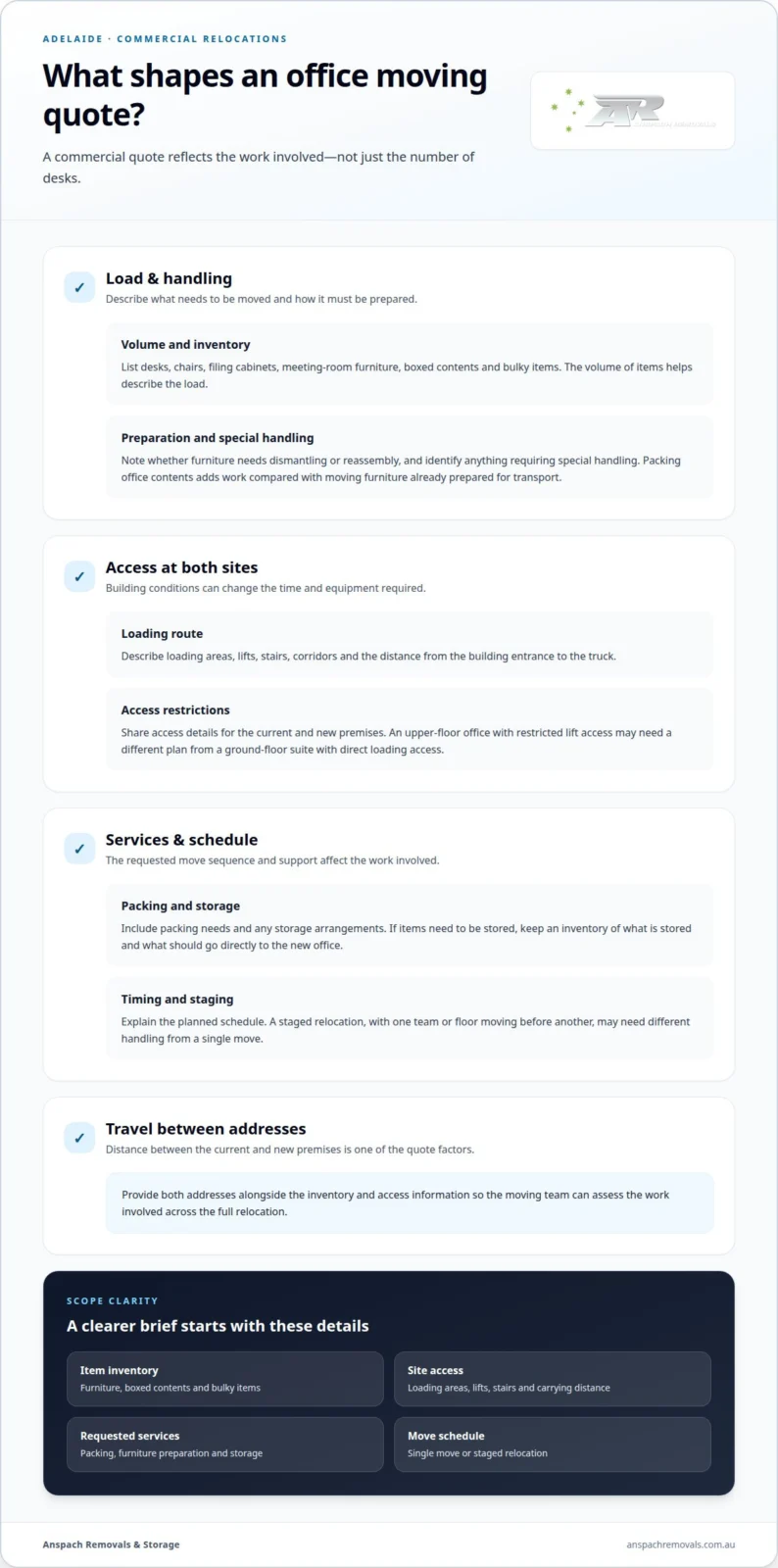
How do Adelaide office movers price commercial relocations, and what affects the quote?
A commercial moving quote reflects the work involved, not just the number of desks. Factors include the volume of items, travel between addresses, access at each site, packing needs and any storage arrangements. Moving a furnished office, for example, involves different work from transporting workstations alone.
A clear inventory helps describe the load. List desks, chairs, filing cabinets, meeting-room furniture, boxed contents and bulky items. Note whether furniture needs dismantling or reassembly, and identify anything requiring special handling. Missing details can affect the work required, so an accurate scope helps the mover prepare a relevant quote.
Access can affect the time and equipment needed. Describe loading areas, lifts, stairs, corridors and the distance from the building entrance to the truck. An upper-floor office with restricted lift access may need a different plan from a ground-floor suite with direct loading access. Share access details for both the current and new premises.
The schedule and requested services also shape the estimate. Packing office contents involves more work than moving furniture already prepared for transport. A staged relocation, with one team or floor moving before another, may require different handling from a single move. If items need temporary storage between addresses, include that requirement from the outset.
- Prepare an itemised inventory, including furniture, boxes and bulky equipment.
- Describe access at both locations, including lifts, stairs and loading points.
- Set out packing, furniture handling and storage requirements.
- Explain any staged move or timing constraints in the quote request.
Before accepting a quote, read its scope alongside the proposed plan. Confirm which items are included, what packing work is covered, and how delivery and placement are described. If the office layout changes, update the inventory and destination plan. Clear information helps the mover assess the job and the firm understand what the quoted work covers.
What insurance and liability cover should law firms check when hiring Adelaide movers
Before an office move, distinguish cover for goods in transit from public liability cover. Goods-in-transit cover relates to items being moved, while public liability generally concerns injury or property damage involving others. They address different risks: damage to a filing cabinet and damage to a building entrance raise separate questions about the applicable policy and responsibility.
Read the written terms that apply to the move, not just a general assurance of insurance. Check who is insured, when cover begins and ends, and whether loading, unloading and temporary storage are included. If boxed furniture will be stored between addresses, look for storage terms specifically rather than assuming transport cover continues automatically.
Review limits, exclusions and excesses against the items being moved. An office chair and a specialist server may have different values and handling needs. Check how the policy treats computers, fragile equipment, archived files or items packed by the firm. Confidentiality is a separate concern: insurance does not control who can access client records or how they are handled.
- Request the relevant policy schedule or certificate and confirm its dates.
- Match declared item values to the furniture and equipment in the move.
- Read exclusions for packing, fragile items, electrical equipment and storage.
- Understand how to report damage, including required records and timeframes.
Keep an inventory and photograph valuable items before packing. Record existing marks on a boardroom table or damage to a monitor, then note any new damage at delivery. Give the mover a written description of high-value equipment and agree how to report an incident. Clear records help establish what was moved and what happened.
Planning an Adelaide office relocation? Discuss your commercial move and its handling requirements.
In South Australia, the cooling-off period for a property purchase expires at the end of the second clear business day, with the starting point depending on when the purchaser receives the Form 1. New AML/CTF laws affect law firms, conveyancers and accountants across Australia from 1 July 2026.
Clear documentation is useful beyond moving day, while insurance terms remain a separate matter.
Anspach Removals & Storage
Anspach Removals & Storage can coordinate the physical move when a legal practice relocates or a property move needs careful planning. Its Office & Commercial Relocations service supports business moves, while Local Moves, Country Moves and Interstate Moves cover different destinations.
For a law firm, preparation starts with a clear moving scope: the premises being vacated, the destination, the furniture and packed items to transport, and any storage needs. Keep responsibility for confidential files and IT arrangements clear within the firm, and outline how furniture and other belongings should be handled. This aligns the move plan with the office’s operational needs without confusing transport with legal or technical services.
If you’re organising a law office relocation or a related residential move, contact Anspach Removals & Storage to discuss the moving requirements.
Plan the next move with clarity
A law office relocation is a chance to decide what moves, what stays and how the new workplace should function. Set a practical priority list with your team, including the items that must be ready first and arrangements that should remain separate from the physical move. This gives everyone a clearer role as the changeover approaches.
Whether your next move is local, across South Australia or interstate, the right support depends on the destination and work involved. Law firm movers in Adelaide can manage the physical relocation, while your staff retain control of legal files, IT arrangements and client communications.
When you’re ready to discuss the moving requirements, contact Anspach Removals & Storage. A clear first conversation can help turn a complex transition into a considered plan, one step at a time.