
A calmer move often comes from making fewer decisions at once, not trying to do everything faster. If you’re wondering how to reduce moving stress, start by breaking the process into manageable steps and deciding what needs your attention first.
It’s understandable to feel pulled in several directions. There are belongings to protect, details to remember and a familiar home and routine to leave behind. A clear plan can help you feel more in control, while keeping a few everyday habits steady can make the transition feel less jarring.
This guide covers practical ways to prepare before moving day, share responsibilities and settle into your new home with less pressure. You’ll find ideas for organising tasks, protecting important routines and making key decisions early. When you’d like help with the physical workload, Anspach Removals & Storage brings over 22 years of experience as a South Australian family business, providing packing, loading, transport and off-loading for local, country and interstate moves. Having an authorised person at both pickup and drop-off to direct placement also helps you stay involved without taking on every task yourself.
Key Takeaways
- Learn how to reduce moving stress by turning a long to-do list into small, scheduled actions.
- Decide which jobs you’ll manage yourself and which you can delegate, while keeping key choices in your hands.
- Prepare essentials, important documents and clear placement directions to make moving day easier to manage.
- Protect familiar routines where you can, helping make the emotional shift into a new home feel more manageable.
- See how Anspach Removals & Storage’s packing, loading, transport and off-loading can help ease the workload for local, country and interstate moves.
Why does moving feel so stressful? Understand the pressure before it builds
A move asks you to make decisions, handle physical jobs and adjust to a change in your home life, often at the same time. You might be packing while keeping up with work, coordinating access and thinking about what it means to leave a familiar place. That combination can make even straightforward tasks feel harder to manage.
Moving stress can build when practical tasks, uncertainty and change overlap. These pressures often affect one another: unclear timing may hold up packing, while disrupted routines can leave you with less energy to make decisions.
The emotional side deserves space alongside the logistics. A home can hold memories and familiar rhythms, so leaving it may feel significant even if the move is welcome. A general overview of the psychological effects of relocation recognises that relocation can be a stressful life event. Noticing what feels difficult is a useful first step towards deciding what preparation or support would help.
Which parts of a move commonly create the most pressure?
Packing, timing and coordinating people can all compete for your attention. You may be deciding what to pack first while arranging keys, access or help from family. Pressure points differ from household to household, so name yours before choosing solutions.
- Workload: Which physical or organising tasks feel like the biggest drain?
- Uncertainty: Which details, such as timing or who is doing what, still feel unclear?
- Change: Which routines or familiar parts of home will you miss most?
There’s no need to judge your answers. Identifying the hardest part helps you focus your effort where it can make a difference, rather than trying to fix everything at once.
What can you control, even when the move feels uncertain?
You can prepare for the parts within reach: sort belongings, keep important information accessible and communicate your priorities to the people involved. You can also decide what needs attention first. These steps won’t remove every unknown, but they can make your next actions clearer.
Other factors may change despite careful preparation, including timing or the availability of people helping. Leave room to adapt rather than treating every change as a sign that the whole plan has failed. If uncertainty rises, ask: What’s the next useful decision I can make? It might be confirming a detail, setting aside essentials or telling someone where you need help.
That’s a practical starting point for how to reduce moving stress: separate what you can prepare from what you’ll need to respond to, then take one manageable step. A move can still bring pressure, but recognising its sources gives you a steadier basis for deciding what comes next.
How to plan a move that feels manageable, not overwhelming
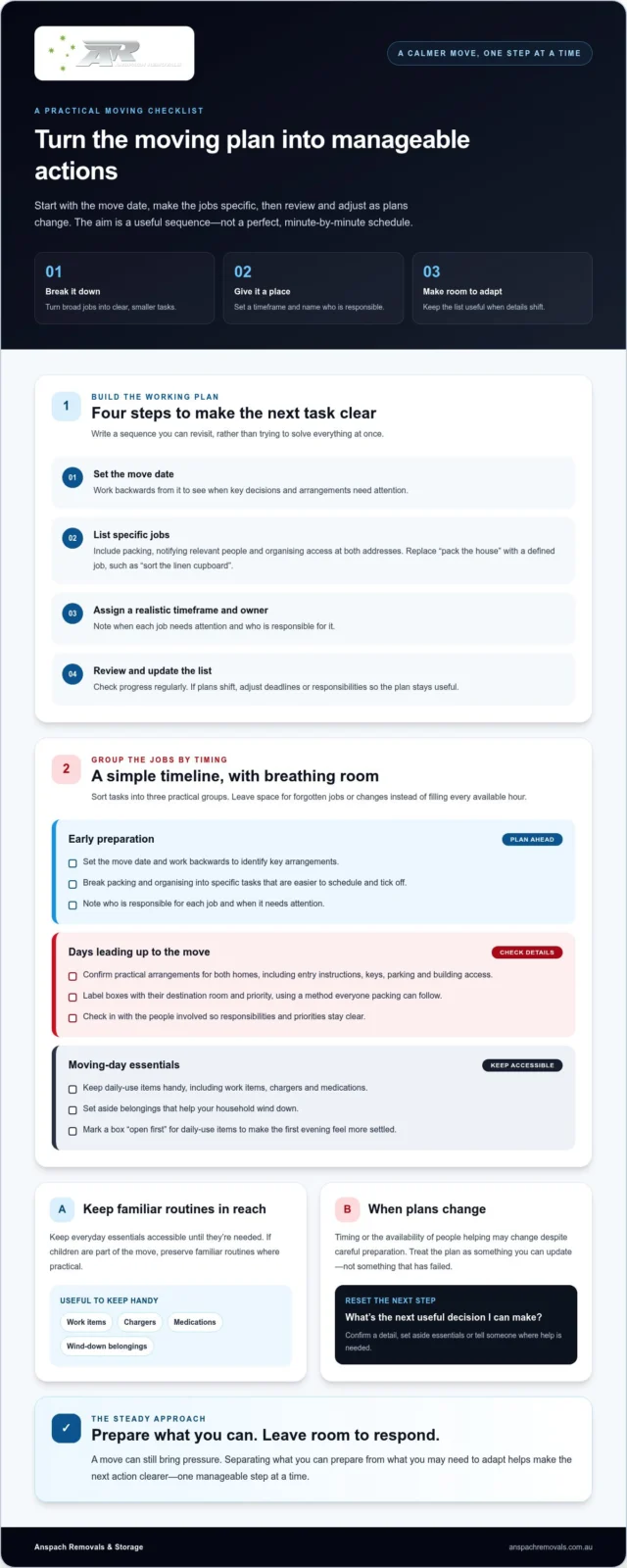
A useful moving plan isn’t a minute-by-minute schedule. It’s a clear sequence that turns big decisions into smaller jobs, with enough breathing room to adjust if something changes. Start with the move date, then build a working list of what needs to happen before, during and just after the move.
A short, prioritised task list makes the next action easier to identify. Instead of writing “pack the house”, break it into specific jobs such as “sort the linen cupboard” or “label boxes for the spare room”. A defined task is easier to schedule and tick off, which can make the plan feel less daunting.
- Set the move date. Work backwards from it to identify when key decisions and arrangements need attention.
- List the tasks. Include packing, notifying relevant people and organising access at both addresses.
- Assign deadlines. Give each task a realistic timeframe and note who is responsible.
- Review progress. Check the list regularly and adjust deadlines or responsibilities when plans shift.
How can you turn a long to-do list into a simple timeline?
Group tasks by when they need attention: early preparation, the days leading up to the move and moving-day essentials. For an Adelaide move, consider practical arrangements at both homes, including entry instructions, keys, parking and building access. Don’t fill every available hour. Leave space for forgotten jobs or changes, and check in with everyone involved so responsibilities and priorities stay clear.
If something changes, update the task list instead of holding on to an outdated plan. Move unfinished jobs to a new deadline and identify what needs action first. The aim is to keep the plan useful, not perfect.
How do you protect familiar routines while packing?
Keep everyday essentials accessible until they’re needed, including work items, chargers, medications and belongings that help your household wind down. If children are part of the move, preserve familiar routines where practical. The American Psychological Association’s research on long-term effects of moving links frequent childhood relocations with poorer well-being in adulthood, a reminder that a move can affect more than the packing schedule.
Label boxes with their destination room and priority, so you can find what matters without opening everything. Marking a box “open first” for daily-use items can make the first evening feel more settled. Keep the labelling method simple enough for everyone packing to follow.
Planning doesn’t mean you have to manage every task alone. If packing or moving your household’s belongings is taking up too much time, explore Anspach Removals & Storage’s moving and packing support as one way to share the workload while keeping your priorities clear.
DIY or delegate? Share the moving workload without giving up control
Getting help with the physical work doesn’t mean handing over every decision. Choose which jobs to do yourself, share or delegate based on your time, energy and priorities. A practical way to think about how to reduce moving stress is to separate the work from the decisions: someone else may handle a task, while you remain clear about what matters and where your belongings should go.
Start by identifying the jobs that need your personal attention. You might prefer to sort sentimental belongings yourself, for example, while getting help with packing other items or moving furniture. Similarly, when coordinating time-sensitive deliveries, documents or urgent packages during a busy transition, dedicated courier specialists like Sameday Express Inc. illustrate how outsourcing distinct transport tasks can keep schedules on track. There’s no single right balance. The aim is to reduce the tasks competing for your attention without giving up the choices that help you feel in control.
Which moving tasks are easier to hand over?
Professional support can cover packing, loading, transport and off-loading, reducing the physical work and coordination you need to manage at home. You can still decide which belongings you want to pack yourself and what should be prioritised. Use a simple division of responsibilities to make expectations clear:
| Task | Who handles it | Decision that stays with you |
|---|---|---|
| Personal or sentimental items | You or someone you trust | What to keep accessible and how you want it packed |
| Other household packing | You, shared helpers or a packing service | Which rooms or belongings are included |
| Loading, transport and off-loading | You can arrange professional removal support | Which items need priority and where they should be placed |
Use the table as a conversation guide, not a fixed formula. For instance, you may want to pack documents and daily essentials yourself, but delegate most household packing and furniture handling. The same principle applies to specialised requirements such as vehicle relocation; for moves across the United States, professional auto transport services like GAATCO take care of shipping cars so families can avoid the fatigue of long highway drives. Being specific about the division helps prevent duplicated effort and forgotten jobs.
How can you stay involved without managing every detail?
Share your priorities and room-placement directions before moving day. Labels or a short room-by-room list can show where boxes and furniture belong. If any items need particular attention, point them out clearly so they don’t get lost among general instructions.
An authorised person is preferred at both pickup and drop-off to direct placement. Their presence gives the moving team someone to consult about access, priorities and where belongings should go, while you focus on the decisions only you can make. It’s a practical balance: delegate the lifting and logistics, but retain a clear say over your home.
If you’re planning a move around Adelaide, this guide to furniture removalists in Adelaide offers further context on arranging support. Choose a division of work that suits your household, then communicate it clearly. Help should make the move feel more manageable, not leave you feeling removed from it.
What to do on moving day and when plans change
Moving day can bring many small decisions, even when you’ve prepared well. Keep essentials, key contact details and important documents together and accessible, rather than packed among items you won’t need straight away. Think about medications, chargers, keys, identification and any paperwork you may need during the day. This lets you reach important items without searching through boxes.
Clear communication helps everyone work from the same plan. Make sure the people involved know how to access both properties, which belongings need priority and where furniture and boxes should go. If a plan changes, pause and work through it in order: identify what the change affects, update the relevant part of your plan, then tell the people whose tasks or timing have changed. Moving conditions can shift, so avoid relying on a precise delivery time unless it has been agreed as part of your arrangements.
How can you make moving-day decisions easier?
Choose one household contact to communicate priorities and answer practical questions. This gives the moving team a clear point of contact and avoids conflicting directions. Keep room names and labels consistent between the old and new homes, and make placement instructions easy to refer to. If several issues arise at once, deal with the next decision that affects the move instead of trying to solve everything at the same time.
An authorised person is preferred at both pickup and drop-off to direct placement. Before the move, give them the key information: access details, priority items and the intended room for each major piece of furniture. If they can’t be the main household contact, agree on how instructions will be shared so decisions remain clear.
What if move dates do not line up?
A gap between leaving one home and entering the next can mean belongings and daily essentials need separate plans. Decide what you’ll need during the interim, such as clothing, work items and personal documents, and keep those accessible. For belongings that need to be stored between dates, Anspach Removals & Storage recommends Hendon’s Self Storage. Its secure storage options guide offers more information to help you plan that part of the transition.
Some changes may be outside your control. A steady response is more useful than trying to prevent every possible disruption: work out what’s affected, adjust the plan and communicate the update. This practical approach to how to reduce moving stress helps you stay focused on the next step, even if the day doesn’t unfold exactly as expected.
If you’d like experienced help with the moving workload, arrange your move with Anspach Removals & Storage.
How Anspach Removals can make the move feel more supported
Practical support can take some of the physical work and coordination off your household’s plate, while leaving important choices in your hands. Anspach Removals is a South Australian-owned family business with over 22 years of experience supporting local, country and interstate furniture moves. For Adelaide and regional South Australian moves, the team can help you plan and manage the practical stages of your relocation.
How does professional support reduce the practical load?
The moving process can include packing, loading, transport and off-loading. Anspach Removals provides support across these stages, so you don’t have to organise every task yourself. Packing services can help if preparing belongings feels like the biggest job, while you can still choose which personal or everyday items you’d rather pack and keep close.
Customer feedback praises punctuality, communication, professionalism and careful handling. Those qualities matter when someone else is helping with belongings that are valuable, useful or tied to memories. Transit insurance covers damage and loss during transit. It provides cover for that part of the move, without promising damage-free delivery.
If you’re weighing up practical support for an Adelaide move, the local removalists Adelaide guide offers more context. You can also explore Anspach Removals’ furniture removal and packing support as part of your plan.
Support doesn’t mean stepping away from decisions. Share your priorities and placement directions, and decide which jobs you want to keep in your own hands. This can make how to reduce moving stress feel more achievable: delegate the physical workload that is weighing on you, while staying involved in the choices that matter to your household.
What are the next steps to arrange a move?
Start by outlining your move details and the support you want, such as packing or help with the full sequence from loading to off-loading. You can request a written quote, which is valid for 30 days from the date of request. Work must commence within 90 days of quote acceptance. Keep these timeframes in mind as you plan your next steps.
Before moving day, identify an authorised person who can be present at both pickup and drop-off to direct where furniture and boxes should go. Share room names, priorities and placement instructions with them ahead of time. That gives the moving team a clear point of contact and lets you retain a say in how your new home is set up.
Choose the level of help that suits your move, then take the next step with a clear picture of what you need. Request a written quote from Anspach Removals to start planning your move with experienced support.
Take the next step towards a steadier move
Feeling more in control doesn’t mean having every detail settled in advance. It means having a clear next step and making decisions at a pace you can manage. As you move into the next stage, give yourself permission to adjust your plans as circumstances change. A new home takes time to feel familiar, so focus on building comfort one day at a time rather than expecting everything to fall into place immediately.
If you’re still working out how to reduce moving stress, start by deciding what kind of support would make the biggest difference to your household. A clear conversation about your move can help turn that need into a practical plan. You can request a written moving quote and take the next step with Anspach Removals.
Every move is a transition, not just a moving day. With thoughtful support and room to settle in, you can begin making the new place feel like home.
Frequently Asked Questions
Can moving stress affect your sleep or mood?
Yes, moving stress can affect sleep or mood for some people, especially when familiar routines are interrupted or decisions pile up. To support how to reduce moving stress, keep one steady cue, such as your usual wind-down time, and take breaks instead of working late into the night. If distress feels severe, persists or affects daily functioning, speak with a health professional for individual advice.
How can I help children feel less stressed about moving?
Give children clear, age-appropriate information about what’s changing and what will stay familiar. Invite questions and offer a manageable choice, such as which favourite books to pack together or what goes in their personal bag. Keeping a familiar bedtime ritual can provide reassurance amid unfamiliar surroundings. Be honest that settling in may take time, and explain the next step rather than promising the move will feel easy.
How can I help my pet adjust to a move?
Keep your pet’s familiar food, bedding and daily routine as consistent as practical while the home is being packed. Before moving day, plan a calm, secure place away from the busiest activity, and consider how you’ll manage their transition into the new home. Bring familiar items with them and introduce the new surroundings gradually. For advice tailored to your pet’s health or travel needs, speak with your vet.
What should I do if my moving date changes?
First, identify which arrangements depend on the date, such as property access, packing tasks and help from others. Let affected people know about the change, then revise your timeline so everyone is working from the updated plan. Keep essential belongings separate in case the new dates leave a gap between homes. Decide what you’ll need each day during that period and make a separate plan for the remaining belongings.
How long is an Anspach Removals quote valid?
Anspach Removals’ written quotes are valid for 30 days from the date of request. If you accept a quote, the work must commence within 90 days of acceptance. Keep both timeframes in mind as you organise your move, particularly if you’re still settling on dates or coordinating arrangements for an Adelaide relocation. Request a written quote when you’re ready to discuss the move and its requirements.
Is it useful to have someone at both pickup and drop-off?
Yes, Anspach Removals prefers an authorised person to be present at both pickup and drop-off to direct the placement of boxes and furniture. Beforehand, prepare a simple room plan or list of destinations, including any items that need particular placement. This gives the person on site a clear reference when answering practical questions and helps the team follow your directions at each address.