
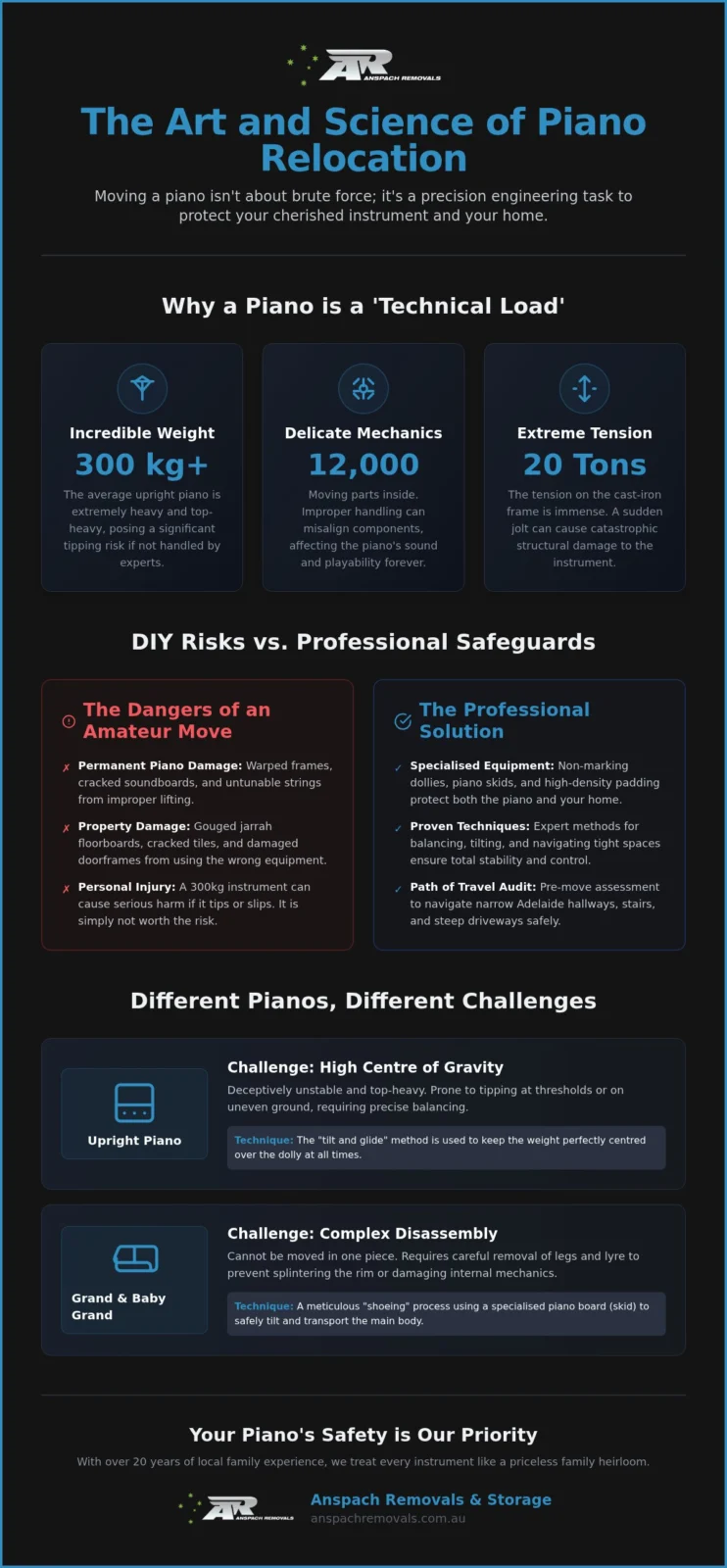
A piano is not just a heavy piece of furniture; it is a 300-kilogram delicate machine with over 12,000 moving parts. When you are looking at your prized upright or grand, you aren’t just seeing wood and wire, you’re seeing years of memories and a significant investment. We understand that the thought of moving such an instrument through a narrow hallway in a classic Prospect villa or up a flight of stairs can be genuinely stressful. You worry about the soundboard cracking, the keys falling out of tune, or those beautiful jarrah floorboards getting gouged by a heavy caster.
Finding the right piano removalists Adelaide residents can trust means looking for more than just brute strength. You need a team that understands the physics of the move and the sentimental value attached to the music. In this guide, we will show you how professional techniques and specialised equipment protect your home and your instrument. We will also cover how to navigate the logistical hurdles of Adelaide’s older architecture, ensuring your piano arrives safely, stays in tune, and remains ready to play the moment it’s settled in your new lounge room.
Key Takeaways
- Understand why moving a piano is a precision engineering task that requires managing a high centre of gravity rather than just using brute force.
- Learn how professional piano removalists Adelaide use specialised non-marking equipment to protect your polished floorboards and doorframes from damage.
- Discover the essential “Path of Travel” audit required to safely navigate narrow bluestone villas and the steep gradients of the Adelaide Hills.
- Identify the different logistical needs for uprights and grand pianos to ensure the delicate internal mechanics stay in perfect tune.
- Find out how over 20 years of local family experience provides the peace of mind that your valued instrument is being treated like a family heirloom.
Why Piano Moving in Adelaide Requires Specialist Expertise
A piano is far more than a bulky piece of furniture. In the removals industry, we classify it as a “technical load.” While a standard wardrobe might be heavy, its weight is predictable and static. Experts at Heavy Furniture Moving highlight that a piano, however, houses a massive cast-iron plate under immense tension, often exceeding 20 tons across the strings. This tension is what gives the instrument its voice, but it also means the frame is under constant stress. This internal complexity makes it incredibly sensitive to even minor shifts or vibrations. When you hire piano removalists Adelaide locals trust, you’re paying for the expertise to manage this delicate balance.
The weight distribution varies significantly between the grand piano and the upright piano. An upright is notoriously top-heavy with a narrow footprint, making it prone to tipping if handled by someone without specific training. A grand piano requires partial disassembly, yet its sheer size makes it a logistical puzzle. Relying on a few strong mates might seem like a cost-saver, but without the right technique, you risk permanent structural damage to the instrument. It only takes one slip for a 400kg instrument to become a dangerous, runaway force.
The Hidden Risks of Standard Removals
Standard furniture dollies are designed for boxes and couches, not 300kg instruments. They lack the reinforced axles and non-marking rubber wheels needed to prevent your jarrah or Victorian ash floorboards from being crushed. Beyond the physical weight, Adelaide’s climate presents its own challenges. A typical South Australian summer move involves extreme temperature shifts that can cause the wood to expand or contract rapidly. Professional piano removalists Adelaide teams use specialised covers and swift loading techniques to mitigate these environmental stressors. Without this level of care, you risk your home’s doorframes being gouged or your flooring suffering structural cracks.
Protecting the Instrument’s Integrity
Improper lifting doesn’t just scratch the surface; it can warp the wooden frame. If the frame loses its shape by even a millimetre, the piano may never hold a tune again. We use specialised, high-density padding to shield high-gloss polyester and delicate French-polished finishes from the slightest friction during the move. Piano stabilising is the process of securing internal components before transit to prevent unwanted movement. By treating the move as a precision engineering project, we ensure your heirloom remains a functional musical instrument rather than just a silent piece of timber.
Different Pianos, Different Challenges: From Uprights to Grands
Every piano presents a unique set of physics problems. The standard upright is the most common instrument found in Adelaide homes, but its tall, narrow profile makes it deceptively unstable. Because the heavy cast-iron plate is situated at the back and top, the centre of gravity is high and rear-set. This makes it prone to tipping if it hits a small bump or a door threshold. Experienced piano removalists Adelaide teams know that an upright must be handled with a “tilt and glide” technique to keep that weight centred over the trolley at all times.
Pianolas present an even more specific challenge due to their internal mechanical components. These “player pianos” contain complex bellows, tracker bars, and tubing that add significant weight and extreme fragility. If these components shift during a move, the self-playing function may be lost entirely. We treat these as high-risk loads, requiring extra stabilisation to ensure the delicate vacuum systems remain airtight during the journey across town.
The Complexity of Moving Grand Pianos
Moving a grand or baby grand is an entirely different operation. You don’t just “lift” a grand; you disassemble it. The Piano Technicians Guild recommends using only professional piano movers to handle this process. The “shoeing” process is critical here. This involves removing the left leg first while supporting the body, then the lyre and remaining legs. We use a specialised piano board, or skid, to distribute the weight evenly during the tilt. This prevents the rim from splintering and protects the internal mechanics from the shock of the transition. For any grand piano move, we always deploy a minimum of three specialists. One person manages the balance while the others handle the heavy lifting and precision positioning.
Digital and Hybrid Pianos
Don’t be fooled by the lack of a cast-iron plate in modern digital models. Hybrid pianos have weighted hammer actions and sensitive optical sensors that can be knocked out of alignment by simple vibrations. We use anti-static wrapping and moisture-proof barriers to protect the electronics from South Australia’s dust and humidity. Even for lighter models, using professional furniture removalists Adelaide ensures the keybed isn’t twisted or stressed during transit. If you’re unsure about the specific requirements for your instrument, getting a professional assessment from a family-owned team who treats your piano like an heirloom is the safest first step.
Specialist Equipment Used by Professional Adelaide Removalists
Moving a piano isn’t just about muscle; it’s about having the right tools for a high-stakes job. Professional piano removalists Adelaide teams rely on a specific kit that goes far beyond what you’ll find in a standard moving truck. One of the most critical items is the heavy-duty piano trolley. Unlike generic hardware store versions, these are built with reinforced steel frames and non-marking rubber wheels. This is vital for protecting Adelaide’s heritage floorboards, such as the polished Baltic pine or jarrah found in older villas, which can easily be crushed or gouged under the weight of a 300kg instrument.
When obstacles like garden steps or uneven paths arise, we use high-tensile cotton webbing and “piano humpers,” which are specialised lifting straps. These allow our team to distribute the weight across their shoulders and hips, providing the control needed to navigate tight spaces without jarring the internal mechanics. For loading, we prefer hydraulic tail-lift trucks over traditional ramps. A tail-lift keeps the piano perfectly level during the ascent into the truck, eliminating the risk of the instrument gaining momentum or slipping on a steep incline.
The Role of the Piano Skid
For grand pianos, a timber skid, also known as a piano board, is an absolute necessity. Think of it as a protective sled that the piano body is securely strapped to once the legs have been removed. This skid allows us to slide the instrument safely through narrow corridors or around tight corners that a trolley simply can’t navigate. We use a technique called “blocking,” where wooden blocks are strategically placed to ensure the piano doesn’t shift even a centimetre on the board. This rigid setup protects the delicate rim and prevents any torsion that could warp the frame during transit.
Protective Materials and Padding
We don’t just throw a blanket over your instrument and hope for the best. We use thick, quilted moving blankets specifically designed for high-value furniture. To ensure these stay in place, we apply industrial-grade shrink wrap over the padding. This isn’t just for security; it prevents the blankets from shifting and causing friction burns on a sensitive French-polished or high-gloss finish. Professional local removalists Adelaide residents trust will also use specialised felt strips to protect delicate ivory or ebony keys before the fallboard is secured. This level of detail ensures the instrument’s exterior remains as pristine as its internal tuning.
Preparing for the Move: Access, Stairs, and Adelaide Architecture
Adelaide’s architectural charm is undeniable, but for piano removalists Adelaide teams, it presents a unique set of logistical hurdles. Moving a grand piano into a modern CBD apartment is a world away from navigating the narrow hallways of a 19th-century bluestone villa in Prospect or North Adelaide. Then there is the geography of the Adelaide Hills, where steep, winding driveways and gravel paths can turn a standard relocation into a high-stakes engineering challenge. We don’t just look at the piano; we audit the entire environment to ensure a zero-damage outcome.
Success starts with a meticulous “Path of Travel” audit. This isn’t just about whether the piano fits through the front door. We evaluate the turn radius at the end of every hallway and the clearance height of every chandelier. If your move involves stairs, we need to know the exact number of steps, the material of the staircase, and whether there are any landings. A “stair-climb” often requires an additional crew member or specialised ramps to maintain a constant level of control. By identifying these variables early, we prevent the “stuck in the doorway” nightmares that occur when movers are under-prepared.
Navigating Adelaide’s Heritage Homes
Victorian and Edwardian cottages are famous for their tight 90-degree turns and narrow doorframes. In these spaces, a piano often has to be turned on its side or “end-on” to clear a pinch point. This is where protecting your home’s history becomes as vital as protecting the instrument. High-pressure loads from a 400kg piano can easily crack original Baltic Pine or Jarrah floorboards if the weight isn’t distributed correctly. We use protective runners and specialised boards to ensure your home’s character remains intact, no matter how tight the squeeze.
Checklist: Is Your Property Ready?
Preparation on the morning of the move can save hours of frustration. A clear path is a safe path, so please ensure all rugs, hallway tables, and wall hangings are removed before the team arrives. We recommend measuring the diagonal clearance of your external doors, as this is often the most restricted point. Don’t forget to secure your pets and keep children in a designated safe area; a moving piano has a lot of momentum and requires the crew’s full concentration. If you are moving further afield, be sure to inform your interstate removalists Adelaide about any gravel driveways or steep inclines at the destination. Ready to get your move started? Contact our family-owned team today for a tailored piano moving quote that treats your instrument like the heirloom it is.
Why Anspach Removals is Your Choice for Piano Relocations
Choosing piano removalists Adelaide residents can rely on shouldn’t feel like a gamble. Since 2002, Anspach Removals & Storage has been a fixture of the South Australian community. We are a family-owned and operated business, which means we bring a level of personal accountability that large, faceless corporations simply cannot match. When you trust us with your instrument, you aren’t just another booking on a spreadsheet; you are a neighbour. We understand that a piano is often the heart of a home, and our 20 plus years of experience ensures that heart keeps beating in your new location.
Sometimes, the timing of a move doesn’t align perfectly. If your new lounge room isn’t ready for its centrepiece, we offer an integrated solution to keep your instrument safe. Our secure storage Adelaide facility provides a protected environment where your piano can wait until you are settled. This seamless transition between transport and storage removes the stress of coordinating multiple contractors. We pride ourselves on transparent communication and reliable scheduling across the entire Adelaide metropolitan area.
A Local Legacy of Care
Our expertise extends far beyond the suburban streets. We have a deep understanding of country moves South Australia, handling the unique challenges of regional transport with the same precision we apply to a city villa. Every relocation is backed by a professional, fully insured team that understands the value of punctuality. We believe in honest, clear pricing. You will never face hidden “piano surcharges” or unexpected fees at the door; the price we quote is the price you pay for our specialist care.
Booking Your Move with Anspach
Getting started is a straightforward process. To provide you with an accurate and reliable quote, we just need a few specific details about your instrument. Tell us the brand, whether it is an upright or a grand, and any specific access challenges we discussed earlier, such as stairs or tight landings. We can easily combine your piano relocation with a full house move, providing a single, coordinated point of contact for your entire journey. Contact Anspach Removals & Storage for a piano moving quote today.
Secure Your Musical Investment with Local Expertise
Moving a piano is a precision engineering task that requires more than just muscle. It involves understanding the unique weight distribution of your instrument and navigating the specific challenges of Adelaide’s heritage architecture. By choosing a team that uses specialised non-marking trolleys and timber skids, you ensure that both your instrument and your home’s jarrah or Baltic pine floorboards remain in pristine condition. Our specialists manage the physics of the move so you can focus on the music.
Anspach Removals & Storage has been South Australian owned and operated since 2002. We bring decades of experience to every move, from narrow bluestone villas to regional country relocations. You can rest easy knowing our family-owned team treats your heirloom with the same care we would our own. Don’t risk the structural integrity of your instrument with standard movers or DIY attempts. We have the expertise and the right equipment to keep your piano safe.
Ready to ensure your piano arrives in perfect tune? Request a Free Piano Moving Quote from Anspach Removals and let our specialist piano removalists Adelaide team handle the heavy lifting for you. We look forward to helping you settle into your new home with your music intact.
Frequently Asked Questions
Do I need to get my piano tuned immediately after moving?
You should wait at least two to four weeks before tuning your piano after a move. This period allows the instrument to settle into the new humidity levels and temperature of your home. The wood needs time to expand or contract before a technician can achieve a stable tune. Tuning it the day it arrives is often a wasted effort as the strings will continue to shift as the soundboard acclimatises.
How much does it typically cost to move a piano in Adelaide?
The cost for piano removalists Adelaide services depends on several specific factors rather than a flat fee. We consider the type of instrument, the total travel distance, and the complexity of access at both properties. For example, a ground-floor move is priced differently than a relocation involving multiple flights of stairs or a steep driveway. We provide tailored quotes to ensure you only pay for the specific resources your move requires.
Can you move a piano up or down a flight of stairs?
We can certainly move pianos up or down stairs, provided the staircase is structurally sound and offers enough clearance. This type of move usually requires a larger crew and specialised equipment like high-tensile straps or ramps to maintain total control. It is vital to disclose the number of steps and any landings during the quoting process so we can arrive fully prepared for the heavy lifting involved.
What information do I need to provide for a piano moving quote?
To provide an accurate quote, we need to know the piano’s brand, model, and type, such as whether it is a standard upright or a baby grand. Detailed information about the access route is also essential. This includes the number of stairs, any tight turns in hallways, and the presence of gravel or steep driveways. Providing photos of the entry and exit points can help our team assess the logistics more effectively.
Is my piano insured during the move with Anspach Removals?
Your instrument is covered by our professional insurance while it is in our care. We understand that a piano is both a financial and emotional investment, so we maintain comprehensive transit insurance to give you peace of mind. For specific details regarding the level of cover or to discuss additional requirements for high-value heirlooms, please speak with our office team during your booking process to ensure you have the protection you need.
Can you store my piano in your Adelaide facility for a few months?
We offer secure, climate-monitored storage solutions at our Adelaide facility if your new home isn’t ready. This is a common requirement for people undergoing renovations or waiting for a property settlement. Your piano will be professionally padded and stored in a clean, safe environment. When you are ready to receive it, we simply coordinate a delivery time that fits your schedule, ensuring a seamless transition for your valued instrument.
How many removalists are needed to move an upright piano safely?
A standard upright piano move typically requires at least two professional removalists, though three are often used for added safety. For grand pianos or moves involving complex stairs and narrow turns, we always deploy a larger team. Having the correct number of specialists ensures the weight is distributed safely and the instrument remains perfectly balanced throughout the entire process, preventing any risk of tipping or structural damage to your home.
What happens if it is raining on the day of my piano move?
If it rains on the day of your move, we use heavy-duty waterproof covers and non-slip mats to protect your instrument and your flooring. Our priority is the safety of the piano and our crew. In the event of extreme weather or dangerous conditions that could compromise the instrument’s integrity, our piano removalists Adelaide team will communicate with you immediately to reschedule. We always aim to complete the move as planned while maintaining high safety standards.