
Moving fewer things starts with one clear decision at a time. For decluttering before a move in Adelaide, sort belongings into four groups: keep, donate, sell and discard. Begin around six to eight weeks before moving day, so you have time to make considered choices before packing starts.
It’s easy to put off sorting when every item seems to carry a memory or a possible use. A simple test can help: consider whether you’ve used something in the past 12 months, whether it suits your next home and whether anyone else in the household values it. If you’re unsure, set it aside and revisit the decision rather than rushing to let it go.
This guide explains how to decide what to keep, make steady progress before packing and clear your home or workplace one area at a time. You’ll also find practical ways to involve household members, so everyone has a say about shared belongings. A clear sorting plan helps you focus on what matters and makes the move feel more manageable.
Key Takeaways
- Sort belongings into keep, donate, sell and discard groups, and discuss shared items before letting them go.
- Use recent use, fit for your next home and personal value to guide decisions; give uncertain items another thought before deciding.
- Start decluttering well before packing and tackle a small, manageable area at a time to keep progress steady.
- Work through home and work spaces systematically, beginning with areas you use less often and keeping only what serves a purpose in the new space.
- Set a time for household members to sort together so everyone can have a say in shared belongings.
1. How To Declutter Before Moving?
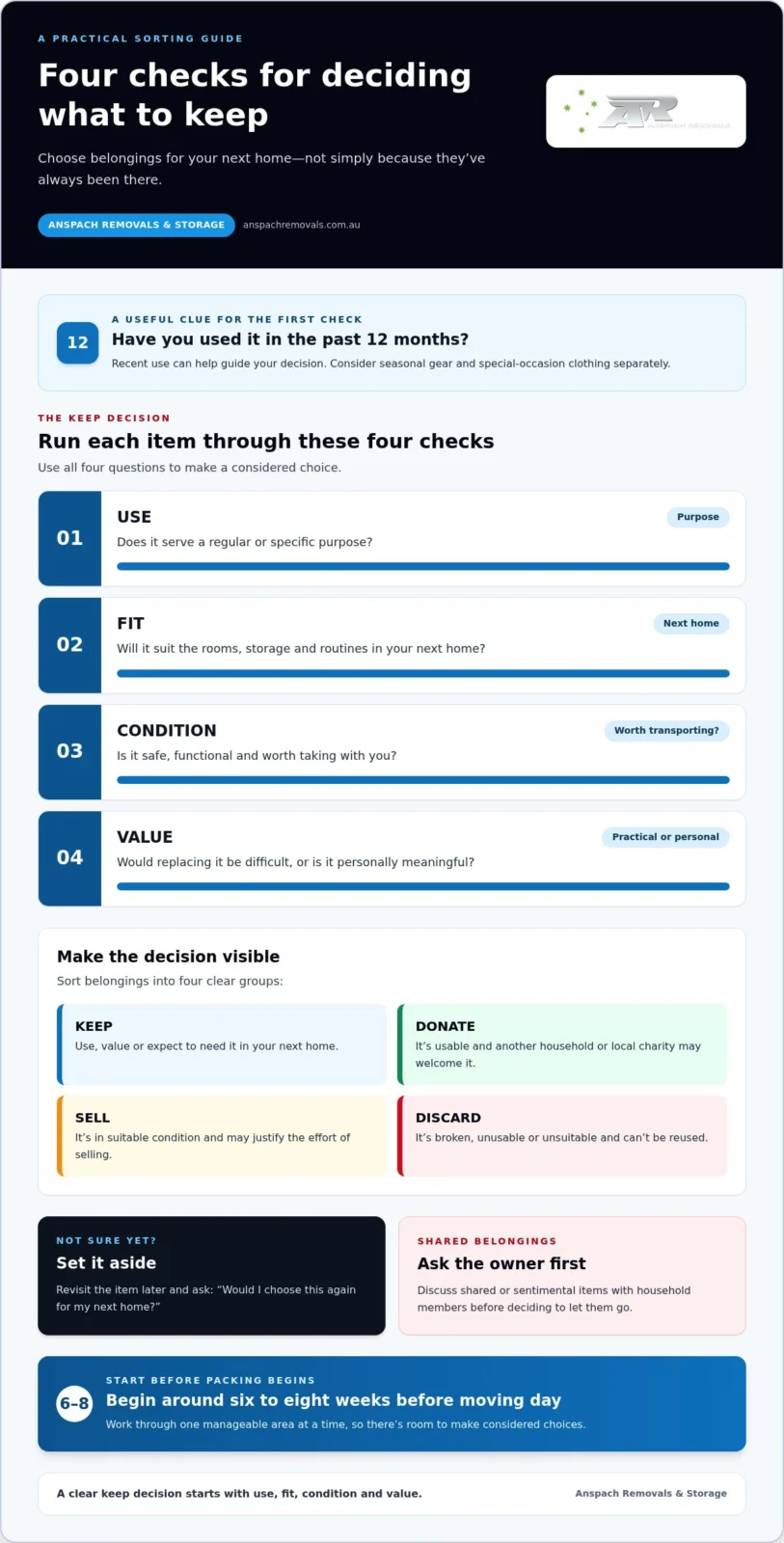
Start decluttering before a move in Adelaide around six to eight weeks before moving day. Choose one area, such as a linen cupboard, and sort each item into keep, donate, sell or discard. Use four labelled tubs, boxes or floor zones to keep decisions visible. This simple system organises belongings and reduces the chance of packing items you don’t intend to take.
- Keep: belongings you use, value or expect to need in your next home.
- Donate: usable items another household or local charity may welcome.
- Sell: items in suitable condition that may justify the effort of selling.
- Discard: broken, unusable or unsuitable items that can’t be reused.
Assess each item against your next home, not just your current routine. Measure a bookshelf against the new room, for example, or consider whether a spare appliance has a practical use. Ask other household members before removing shared belongings, including furniture, keepsakes and children’s items. Let the owner decide about their belongings rather than making a rushed choice.
Donate clean, usable belongings to a charity that accepts that type of item. You could also sell suitable pieces at a garage sale, but weigh the likely return against the time needed to price, display and manage them. A busy move can make selling more effort than it’s worth. Set a decision date, then donate suitable leftovers instead of carrying them into moving week.
Adelaide council hard-rubbish rules and fees depend on the council serving your address. Check its waste information for collection options, booking requirements, accepted items and charges. Match each item to that guidance before sorting it for collection.
Junk-removal costs in Adelaide depend on the amount and type of material, access, labour and disposal requirements. The price depends on the job and is provided after a quote request; separate reusable belongings from rubbish to clarify what needs removal.
For unwanted items, donate reusable goods to a charity and follow your council’s waste and recycling guidance for hard rubbish and e-waste. Check the accepted-item instructions before putting anything out or taking it to a collection point, as different materials may have different disposal routes.
Keep paint, batteries and chemicals separate from ordinary belongings, and identify each type before moving day. Follow South Australian council or household hazardous-waste disposal instructions for the correct collection or drop-off route. Don’t pack these materials with items intended for the moving truck.
Before packing, organise the keep group by destination room. Label boxes with the room and a brief contents description, such as “kitchen, mugs”. Keep donation and sale items away from packed belongings, and handle discards through the appropriate council route. This separation makes it easier to load only what belongs in your next home.
2. Deciding what to keep
Choose belongings for your next home, not simply because they’ve always been there. For each item, consider its use, condition, difficulty of replacement and personal importance. A saucepan used weekly has a clear purpose; a duplicate serving dish may not. This makes downsizing a practical review, rather than a judgement about the memories attached to your belongings.
Use the past 12 months as one clue: have you used the item during that period? Consider seasonal gear and special-occasion clothing separately, since their value may not show through frequent use. Then picture where each item will go. A desk may be useful, but not if your new work area has no space for it.
For a clear decision, ask yourself:
- Use: Does this item serve a regular or specific purpose?
- Fit: Will it suit the rooms, storage and routines in your next home?
- Condition: Is it safe, functional and worth transporting?
- Value: Would replacing it be difficult, or is it personally meaningful?
Compare similar items side by side before choosing. If you own three lamps, decide which suit the new rooms and which duplicates can go. Group similar clothes together; seeing them side by side makes it easier to spot what you actually wear. This approach also works for tools, kitchenware and hobby supplies.
When a decision feels difficult, set the item aside and sleep on it. Revisit it with a specific question: would I choose this again for my next home? A family heirloom might deserve a place because of its story, while an unused appliance may simply occupy valuable cupboard space. Ask the owner before deciding about shared or sentimental belongings.
For items you’re keeping, identify their destination before packing. Label a note or box with a room, such as “study”, and group related belongings together. If an item has no clear place, reconsider whether it belongs in the keep group. This small step helps stop unpacked boxes becoming another source of clutter after moving day.
Cleaning offers another useful test. Empty a cupboard or shelf, then return only the items you’ve chosen to keep. For example, place everyday crockery at the front and set aside chipped or unused pieces for a decision. Keep uncertain belongings in a separate, clearly marked area rather than mixing them with packed items.
Once your keep list is settled, choose moving boxes for packing that suit the belongings and their destination rooms. A clear list helps you pack with purpose, instead of carrying undecided items into your new home.
3. Decluttering before packing
Start decluttering eight weeks before moving day, then pack only after sorting each area. This gives you time to make decisions without turning every room into a half-packed obstacle course. If eight weeks isn’t possible, begin with the least-used spaces and keep a clear path through the home.
When should I start decluttering before a move in Adelaide? Begin eight weeks before moving day where possible, and spend 15 minutes a day sorting one small area. A short daily session, such as clearing one shelf or a bedside drawer, keeps the work manageable and helps prevent packing fatigue.
Use a simple order to keep decisions and packing separate:
- Sort: choose what stays before opening a box.
- Clear: remove donation, sale and discard items from the work area.
- Pack: box the remaining belongings by destination room.
At six weeks before moving day, gather packing supplies so they’re ready once sorting is complete. Keep boxes, packing tape, labels and protective material together in one accessible spot. Put a clean-up area and a rubbish or recycling bag in each room, making it easier to separate unwanted items as you work.
Begin packing belongings you don’t use regularly four weeks before moving day. Once you’ve decided what to keep, pack seasonal decorations or spare linen. Aim to complete most packing two weeks before moving day, leaving everyday essentials accessible for the final stretch.
Choose box sizes to suit their contents. Pack heavier belongings in smaller boxes and lighter items in larger ones, so each load is easier to handle. Wrap breakables in sturdy protective material before packing them. Fill gaps to limit movement, then seal each box securely with packing tape.
Label every box with its destination room and a short contents description, such as “bedroom, spare linen”. Place the label where it’s easy to see when boxes are stacked. Mark fragile contents clearly, and keep important valuables, passports and jewellery with you rather than in a moving box.
Plan for the first 24-48 hours in your new home. Keep an essentials box with items you’ll need straight away, such as toiletries, phone chargers and basic kitchen items. Put kitchenware boxes near the top of the pile so they can be moved quickly into the kitchen after arrival. This order makes unpacking more straightforward and stops useful items disappearing beneath less urgent boxes.
4. Reducing clutter in homes and work spaces
Start in the spaces you use least, such as a garage, shed or spare room. These areas often hold belongings you can review without disrupting daily routines, particularly in a multi-storey home. Work through one room at a time rather than opening cupboards across the whole house. A contained area makes it easier to see what you own and decide what belongs in your next home.
Within each room, take one shelf, drawer or surface at a time. Bring its contents together, then sort them by purpose and value. For example, group gardening tools, spare light bulbs or archived paperwork separately. This reveals duplicates and items without a clear purpose. Keep the work area usable by clearing each small section before moving on.
Apply the same method to a home office or workplace. Sort stationery, files, equipment and shared supplies by how they support current work. A box of old cables may contain useful chargers, but keeping every unidentified lead creates clutter. Match equipment to devices still in use, and set aside obsolete paperwork for appropriate handling before moving.
Plan around the spaces at your new address, not an idealised version of them. Consider where a desk, dining table or storage unit will fit and whether it suits how you’ll use the room. If the new home has less cupboard space, prioritise items with a clear purpose. This is especially useful when downsizing, as familiar furniture may not suit the new layout.
Clothing is easier to assess when similar items are grouped together. Look at coats, shoes or workwear as a set, rather than judging each piece alone. Clothes you haven’t worn for two years are probably clutter, apart from special-occasion clothing. Check condition and fit, then choose what you expect to wear in your next home. A formal outfit or seasonal coat may still have a specific use.
To stop clutter building up again, remove items as soon as you decide they’re no longer needed. Don’t move them from a cupboard to a spare room, where they can become another unfinished pile. Put donations together, keep sale items in one designated place, and arrange discards through the appropriate disposal route.
Before leaving each space, look at the cleared shelves and surfaces. Ask whether every remaining item has a role, a home or a reason to stay. For instance, keep the printer and paper used for work, but review spare stationery that has sat untouched. This final pass helps you prepare a practical home or workspace, rather than simply moving clutter to a new address.
After moving, keep spaces clear by giving incoming belongings a designated place straight away. A basket for mail near the entry or a drawer for household tools can stop items spreading across benches. When something new comes in, consider whether an older item has become redundant. This small habit helps prevent carefully cleared rooms from filling up again.
5. Involving household members
Set a specific time for everyone to work together, rather than relying on spare moments. Add a shared decluttering session to the household calendar and choose one clear task, such as sorting the hallway cupboard. Agree on a finish point before starting, such as clearing one shelf. A defined session helps everyone know what to expect and makes progress easier to see.
Give each person responsibility for their own belongings. Children can choose toys to keep, while adults review shared kitchenware or garage tools together. Agree that nobody will discard a shared item without asking its owner. This avoids rushed decisions about a keepsake, an appliance someone uses or equipment needed for a regular activity.
Choose tasks that suit each household member. A younger child might group books into “keep” and “donate” piles, while an adult checks that the books are clean and usable. Someone with limited time can help by labelling boxes or listing items for donation. Match each task to the person’s ability and available time.
Use a visible system that everyone understands. Mark separate areas or containers “keep”, “donate”, “sell” and “discard”, then explain what belongs in each. If someone is unsure about an item, put it in a temporary review area rather than letting it drift into a box. Set a time to revisit those decisions together.
Sentimental belongings need a slower conversation. Invite each person to choose meaningful items, such as a family photograph, school artwork or inherited serving dish. If several people value the same object, discuss whether it can be shared, displayed or kept by one person. Photographing children’s artwork can preserve the memory without keeping every sheet of paper.
For teenagers or housemates, allow privacy and control over personal spaces. Ask them to sort their own desk, wardrobe or bedroom, then agree on a date to have unwanted belongings ready for collection or disposal. Don’t clear someone else’s drawer while they’re away. A jointly agreed plan makes responsibility clear without turning decluttering into an argument.
Keep shared sessions practical: choose one room, gather the bags and boxes you need, and finish by clearing the floor. After sorting the garage, for example, move donations to one designated spot and keep selected tools together. The next session can tackle another area, such as the pantry or linen cupboard. This steady rhythm lets household members help without taking over one another’s decisions.
Once everyone has agreed what’s moving, write down any outstanding decisions and who will handle them. A short list might name a child’s old bike, shared camping gear or a lounge that needs measuring against the new room. If you’re ready to organise the move after sorting household belongings, plan your household move.
Anspach Removals & Storage: Local Moves
Once you’ve decided which belongings are coming with you, Anspach Removals & Storage can help with the move. For an Adelaide household moving locally, a planned move is a clear next step after sorting and packing. The team also handles country moves across South Australia and interstate relocations, as well as office and commercial relocations.
A settled list of what’s staying helps you prepare for the move and explain what needs to be transported. If you need storage during the transition, Hendon’s Self Storage is the recommended option. Choose the move that fits your destination, whether you’re moving within Adelaide, heading elsewhere in South Australia or relocating interstate.
When you’re ready to discuss your move, contact Anspach Removals & Storage.
Set up your next move with a clear plan
The belongings you take will shape how you settle into your next home or workspace. Treat your final keep list as a practical starting point: it shows what needs to move, what may need storage and what you can leave behind. With decluttering before a move in Adelaide, the goal isn’t an empty home. It’s making room for the things that fit your next chapter.
Once you’re ready to plan the transport, Anspach Removals & Storage offers Local Moves, Country Moves and Interstate Moves, as well as Office & Commercial Relocations. The right option depends on your destination and whether you’re moving household or workplace belongings.
Take the next step when your plans are taking shape. Contact Anspach Removals & Storage to discuss your move. A considered start can help you move forward with greater clarity and confidence.
Frequently Asked Questions
How To Declutter Before Moving?
Start with belongings that are easy to assess, such as expired pantry goods or outdated paperwork. For decluttering before a move in Adelaide, compare larger pieces with the floor plan and storage space in your next home. Keep a short inventory of furniture and appliances, noting their condition and intended room. This gives you a practical reference when deciding what to pack and helps prevent unsuitable items taking up space in your new home.
Need help with decluttering?
Ask household members to take responsibility for their own belongings, and agree who will decide about shared items. If sorting feels difficult, work alongside someone who can keep the session focused and record decisions. Once you’ve chosen what’s moving, Anspach Removals & Storage’s Packing Services can help with packing. For example, finish sorting a study first, then prepare its selected books, documents and equipment.
What do decluttering services include?
Decluttering services commonly involve reviewing belongings, sorting items by their next destination and helping clear selected spaces. Some may also help organise items for donation, sale or disposal. These tasks differ from packing: decluttering decides what stays, while packing prepares chosen belongings for transport. Anspach Removals & Storage offers Packing Services for belongings you’ve decided to move, such as kitchenware, books or home-office equipment.
What items should I sell, donate, recycle, or throw away before moving?
Sell clean, working items that may interest someone else, such as a usable desk or spare appliance. Donate wearable clothing, books and household goods in good condition, following the organisation’s acceptance guidelines. Recycle paper, cardboard and eligible electronics through appropriate Adelaide collection options. Put broken, unusable items into the relevant council disposal stream, and keep batteries, paint and chemicals separate from ordinary rubbish.