
Have you ever stood in the middle of your lounge room, surrounded by half-taped boxes, wondering how on earth you’ve accumulated so much stuff? It’s a familiar scene for many Adelaide families facing the daunting task of relocation. If the fear of a precious heirloom breaking or simply running out of time has you feeling overwhelmed, you aren’t alone. Learning how to pack for a move is more than just a cleaning task; it’s a precise logistics operation that requires a professional touch to get right.
We understand that your belongings represent years of memories, and the thought of them being damaged is genuinely stressful. That’s why we’ve put together this strategic, room-by-room blueprint to help you reclaim your sanity. By following our expert advice, you’ll achieve a move with zero breakages and an organised house from the moment you arrive. This guide provides a manageable timeline and the professional techniques we use to ensure every box is packed with care and purpose.
Key Takeaways
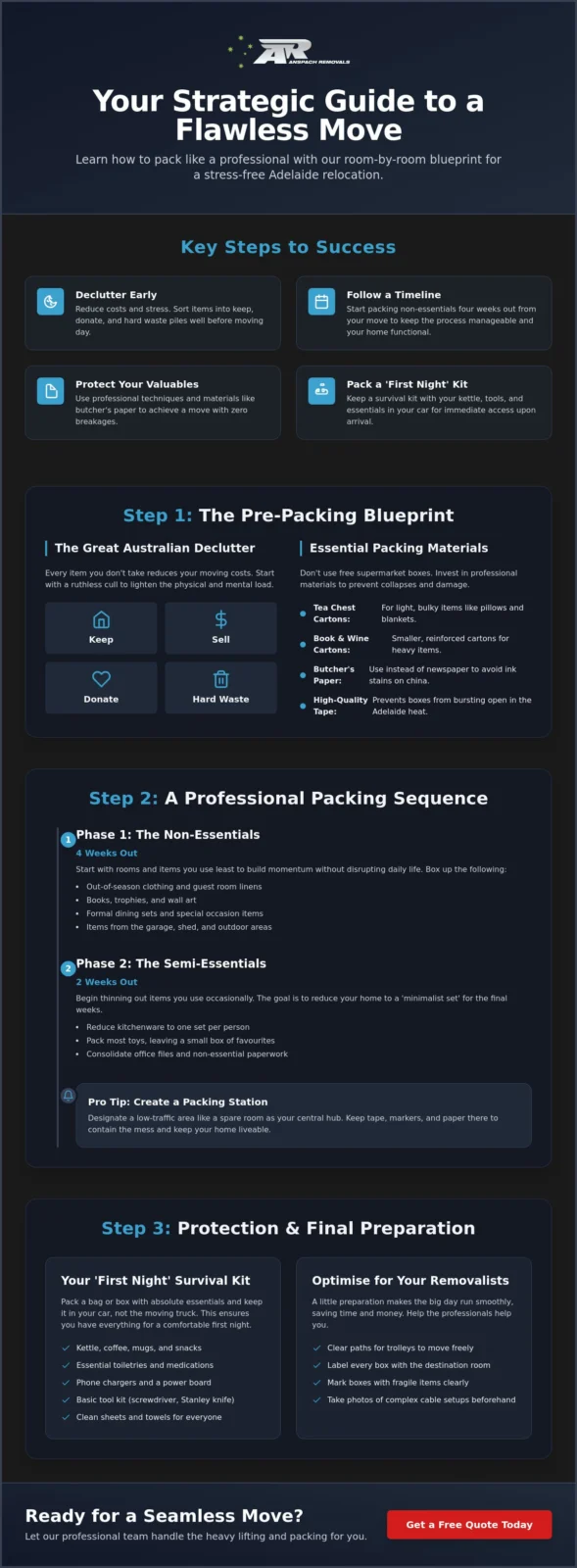
- Reduce your moving costs and stress by decluttering early, categorising your belongings into keep, donate, and hard waste piles.
- Establish a four-week timeline and a dedicated packing station to keep the process manageable while keeping your home functional.
- Master professional protection techniques, such as the ‘Burrito Method’ for glassware, to learn exactly how to pack for a move with zero breakages.
- Create a ‘First Night’ survival kit that stays in your car, ensuring you have your kettle, essentials, and tools ready for immediate use.
- Optimise the big day for your removalists by clearing paths for trolleys and using a clear, room-based labelling system for every box.
The Pre-Packing Blueprint: Decluttering and Sourcing Supplies
Before you even pick up a roll of tape, you need a strategy. Most people think learning how to pack for a move starts with the first box, but it actually begins with what you leave behind. Every item you decide not to take reduces the volume of your load, which is the single most effective way to lower your moving quote. It’s a simple equation: less stuff equals less time, fewer cartons, and a smaller truck. We’ve seen hundreds of moves, and the most successful ones always start with a ruthless cull.
Start by categorising everything into four distinct piles: Keep, Sell, Donate, and Hard Waste. Be honest with yourself. If you haven’t used an item since the last Crows or Port home game, you probably don’t need it in the new house. This stage of the process of relocating is your best chance for a fresh start. It lightens the physical load and clears the mental clutter that often accompanies a major life change.
The Great Australian Declutter
In Adelaide, we’re lucky to have excellent council resources, so make sure you use them. Book your hard waste collection with your local council, whether it’s Burnside, Marion, or Charles Sturt, at least a month in advance. These slots fill up fast, especially during the warmer months. For high-quality items, South Australian donation centres like Vinnies or Salvos are always grateful for furniture and clothing that still has life in it. Before you pull apart the home theatre or the study desk, take a quick photo of the cable setups. It’ll save you hours of frustration when you’re trying to get the TV working on your first night.
Essential Packing Materials List
When considering how to pack for a move, sourcing professional materials is a non-negotiable. Don’t be tempted by free supermarket boxes. They’re often thin, prone to collapsing, and may carry unwanted pests. For a standard 3-bedroom Adelaide home, you’ll typically need between 50 and 80 cartons. If you’re unsure where to source quality cartons, our guide on where to buy moving boxes in Adelaide covers everything you need to know about finding professional-grade supplies. We recommend a mix of ‘Tea Chest’ cartons for light, bulky items and ‘Book and Wine’ cartons for heavy items.
- Tea Chest Cartons: These are the large ones. They’re best for pillows, blankets, and plastic toys.
- Book and Wine Cartons: Smaller and reinforced, these prevent you from overpacking heavy items like kitchenware, tools, and books.
- Butcher’s Paper: Always use clean butcher’s paper instead of newspaper. Newsprint ink can permanently stain your fine china and white ceramics, leaving you with a scrubbing job you don’t need.
- High-Quality Tape: Cheap tape splits and loses its stick in the Adelaide heat. Invest in professional-grade tape and a sturdy dispenser. It’s a small cost that prevents boxes from bursting open at the worst possible moment.
A Professional Packing Sequence: What to Box and When
When you’re figuring out how to pack for a move, the biggest mistake is trying to tackle the whole house at once. Chaos quickly follows. Instead, designate a ‘Packing Station’ in a low-traffic area, like a spare bedroom or a corner of the lounge. This is your central hub. Keep your tape, markers, and butcher’s paper here so you aren’t constantly hunting for supplies. By containing the mess to one spot, the rest of your home remains a sanctuary where you can actually relax at the end of the day.
We always suggest starting with the ‘Junk Room’ or the garage. These spaces often hold the most clutter but the fewest daily essentials. Clearing these areas early builds massive psychological momentum. It also creates a vacant space to stack finished cartons. Remember the ‘Last In, First Out’ rule: the items you pack first, like long-term archives and seasonal gear, should be the ones you won’t need until weeks after you’ve arrived at your new Adelaide address. These boxes will sit at the back of the truck or the bottom of the stack.
Phase 1: The Non-Essentials (4 Weeks Out)
Start your four-week countdown by boxing up everything that doesn’t contribute to your daily life. This includes out-of-season wardrobes, formal dining sets you only use at Christmas, and guest room linens. Empty the garden shed and those outdoor entertaining areas that won’t be used before moving day. Boxing up books, trophies, and wall art early is a great move. It clears visual clutter and makes the task ahead feel much more manageable. If the volume of items feels too high, our team can provide packing services to handle the heavy lifting for you.
Phase 2: The Semi-Essentials (2 Weeks Out)
With a fortnight to go, it’s time to thin out the semi-essentials. Reduce your kitchenware to a ‘minimalist set’—one plate, bowl, and set of cutlery per person. Pack away the air fryer, the bread maker, and the secondary electronics you rarely touch. This is also the time to box up home office archives and organise hobby equipment into labelled bins. For more detailed packing tips on protecting your semi-essentials, focus on using smaller cartons for heavy items to ensure they remain easy to carry. By the end of this phase, your home should look significantly leaner, leaving only the essentials for the final week.
Masterclass in Protection: Packing Fragiles and Bulky Items
When you’re learning how to pack for a move, the focus shifts from scheduling to the physics of the truck. If an item can move inside a carton, it can break. Professional removalists don’t just throw things in boxes; they use specific wrapping techniques to create a buffer against vibration and bumps. One of the most effective trade secrets is the ‘Burrito Method’ for glassware and ceramics. Lay your butcher’s paper flat, place the item at a corner, and roll it diagonally while tucking the sides in as you go. This creates multiple layers of air-trapping paper around the object. Avoid the common mistake of using your t-shirts or towels as padding; while it seems like a space-saver, fabric compresses easily and often leads to uneven cushioning and a massive ironing pile at the other end.
Bulky items and electronics require a different level of care. If you don’t have the original box for your television, don’t panic. Wrap the screen in a soft, non-abrasive moving blanket and secure it with tape, ensuring the tape never touches the screen itself. For large appliances like fridges and washing machines, tape the power cords to the back of the unit so they don’t become a trip hazard. Always remove glass shelves from the fridge and pack them separately using the Burrito Method. When dismantling furniture, place all screws, bolts, and Allen keys into a labelled zip-lock bag and tape it firmly to a large component of that specific piece. For those who want a completely hands-off experience, exploring professional packing Adelaide ensures that even your most delicate items are handled with these expert techniques.
The Golden Rule: Heavy Bottom, Light Top
Weight distribution is where many DIY moves go wrong. Always place heavy items like books or canned goods at the bottom of smaller ‘Book’ cartons. Never use a large tea chest for books; it will become impossible to lift and the bottom may give way. Once the heavy items are in, layer cushions, linens, or crumpled butcher’s paper at the top to fill any remaining gaps. Before sealing the box, perform the ‘Shake Test’. If you can hear or feel anything rattling inside, it isn’t packed safely enough. Add more crumpled paper until the contents are completely immobile.
Packing the Kitchen and Breakables
Kitchens are notoriously time-consuming and fragile. To prevent pressure cracks, always pack your plates vertically, like they are sitting in a dishwasher, rather than stacking them flat. Plates are far stronger on their edges. For stemware and wine glasses, use cardboard cell dividers to keep each glass isolated. Once the carton is sealed, use a thick marker to label it ‘Fragile’ and ‘This Way Up’ on at least four sides. This ensures that no matter how the removalists approach the box, the warning is clear and visible.
The ‘First Night’ Essentials: Your Survival Kit Strategy
Imagine arriving at your new doorstep at 6:00 PM after a long day of heavy lifting. You’re exhausted, the kids are hungry, and all you want is a cup of tea and a hot shower. This is where most people realise they’ve made a tactical error. If your kettle, towels, and bedsheets are buried at the back of a five-tonne truck, your first night will be spent digging through cardboard in a state of frustration. Knowing how to pack for a move effectively means planning for the first 24 hours of total chaos. We always advise our clients to treat their ‘Essentials Box’ like a survival kit that travels in the car with them, not in the removal truck.
Food safety is another critical part of the transition. While your fridge should be defrosted and dry 24 hours before the move, you’ll still have those final perishables like milk, butter, and snacks. Use a high-quality Esky with plenty of ice bricks to manage this gap. Similarly, while you taped your furniture screws to the bed frame in the previous stage, you’ll need the actual tools—the screwdriver, the hammer, and the adjustable wrench—to put it all back together. Keep these tools in your car kit so you can get the beds assembled immediately. There is a massive psychological benefit to having your bed ready to go the moment you feel like collapsing. If you’d rather skip the heavy lifting altogether, we specialise in stress-free local moves that let you focus on settling in.
The Survival Box Checklist
Your essentials box should be the last thing you pack and the first thing you open. It needs to contain everything required to keep the household running until you can start the formal unpacking process. Think about what you’ll need for that first morning in a new kitchen. We recommend including:
- The kettle, a small supply of tea, coffee, and long-life milk.
- Phone chargers, tablet cables, and the remote controls for the TV.
- A set of bed linens and bath towels for every family member.
- A basic cleaning kit containing dish soap, a sponge, and an all-purpose spray to wipe down surfaces before you unpack.
- Essential daily medications and a basic first-aid kit.
Important Documents and Valuables
Paperwork has a habit of disappearing during a relocation. Create a dedicated folder for your most sensitive documents, including passports, birth certificates, and those all-important settlement papers. This folder should stay with you at all times. The same rule applies to high-value jewellery and small family heirlooms that are irreplaceable. Finally, ensure the keys for both your old property and the new one are clearly identified and kept in a secure, accessible pocket. There’s nothing worse than standing at your new front door and realising the keys are taped inside a box labelled ‘Kitchen Misc’.
Optimising for Your Removalists: Final Checks for a Seamless Day
The final stage of your relocation isn’t just about the heavy lifting; it’s about the handover. By the time your crew arrives, your level of preparation dictates the speed of the entire operation. Learning how to pack for a move properly has a direct impact on your final bill. Professional removalists work with a rhythmic efficiency, but that rhythm breaks if they have to navigate around loose items or re-tape poorly sealed cartons. Ensuring your boxes are uniform, taped securely, and stacked in a central area allows the team to load the truck with mathematical precision, often saving significant time on the day.
Before the truck pulls into the driveway, perform a ‘Corridor Clearance’. Removalists use wide trolleys to move multiple cartons at once, so those narrow hallways need to be completely clear of shoes, rugs, and stray toys. A clear path isn’t just a safety requirement; it’s a productivity booster. Don’t forget the final walkthrough of the ‘hidden’ spots. We’ve seen many moves where the dishwasher is still half-full or a tray is left in the oven at the very last second. Check the top of the kitchen cupboards and the dark corners under the stairs to ensure nothing is left behind in the rush.
Labelling for the New House
Your labelling system should serve the people carrying the weight. Always mark your boxes on the side, not the top. When cartons are stacked three high on a trolley or in the truck, the top label becomes invisible. Use a thick permanent marker to write the destination room and a brief list of contents. We also recommend a ‘Priority 1’ label for the most important items. This tells our furniture removalists Adelaide team exactly which boxes should be easily accessible at the new property, ensuring you can find your essentials without a frantic search.
When to Call in the Professionals
There comes a point where DIY reaches its limit. Specialist items like upright pianos, slate pool tables, or delicate antiques require specific equipment and handling techniques that go beyond standard how to pack for a move advice. If you’re managing a complex office relocation or simply don’t have the time to tackle the whole house, a professional service is a wise investment. You can compare packing services Adelaide to determine if a full-service pack fits your lifestyle. Sometimes, the peace of mind that comes with knowing every item is professionally secured is the best way to ensure a truly stress-free move.
Take the Stress Out of Your Adelaide Relocation
Mastered the art of the burrito wrap? Checked the dishwasher one last time? You’re now equipped with the professional blueprint for a successful move. By decluttering early, following a strict four-week timeline, and preparing a first-night survival kit, you’ve already solved the biggest logistical hurdles. Understanding how to pack for a move isn’t just about filling boxes; it’s about protecting your peace of mind while you transition into a new chapter of your life.
At Anspach Removals & Storage, we’ve been a proud, family-owned South Australian business since 2002. We understand that your furniture isn’t just wood and fabric; it’s a collection of memories. That’s why we provide specialised transport for fragile furniture along with comprehensive packing and storage solutions tailored to your needs. Our team is here to act as your supportive partner, taking the physical burden off your shoulders so you can focus on the excitement of your new home.
Get a professional removalist quote from Anspach Removals & Storage today and experience a truly seamless transition. You’ve done the hard work of planning, now let our experts handle the heavy lifting. We look forward to helping you settle in.
Frequently Asked Questions
How many weeks before moving should I start packing?
You should ideally begin the process at least four to six weeks before your scheduled moving date. Start by boxing up non-essential items like seasonal clothing, guest room linens, and books as part of your initial countdown. This gradual approach prevents the stress of a last-minute rush and gives you ample time to declutter your home effectively before the truck arrives.
Is it better to use original boxes for electronics?
Yes, original boxes are the superior choice because the internal foam is custom-moulded to protect that specific device from vibration. If you’ve already recycled the original packaging, use heavy-duty, double-walled cartons instead. Ensure you wrap the electronics in anti-static bubble wrap and fill any remaining gaps with crumpled butcher’s paper so the item cannot shift during transit.
What is the best way to pack hanging clothes for a move?
The most efficient method is using specialised port-a-robe cartons, which feature a sturdy hanging rail inside. These allow you to transfer clothes directly from your wardrobe to the box while still on their hangers. This professional technique saves hours of folding and ensures your suits, dresses, and coats remain wrinkle-free and ready to hang in your new home immediately.
Can removalists move boxes that aren’t taped shut?
No, professional removalists cannot safely transport cartons that aren’t securely taped shut. Open or overfilled boxes are a significant safety hazard because they cannot be stacked in the truck, which leads to wasted space and potential damage. Part of learning how to pack for a move involves ensuring every box has a flat top and is sealed firmly with high-quality packing tape.
How do I pack liquids like cleaning supplies or wine safely?
Liquids should always be packed upright in plastic bins or sturdy cartons lined with a heavy-duty waterproof bag. Ensure all lids are tightened and consider taping them shut for extra security. For wine, always use dedicated wine cartons with cardboard dividers to keep the bottles isolated, preventing them from clinking together and breaking during the journey.
Should I empty my dresser drawers before the move?
You should always empty your dresser drawers to protect the structural integrity of your furniture. While it might seem easier to leave clothes inside, the extra weight puts immense pressure on the drawer runners and the timber frame when the piece is tilted or carried. Emptying the drawers also makes the unit significantly lighter and safer for the removalists to navigate through tight corridors.
What size boxes are best for heavy books?
Small ‘Book and Wine’ cartons are the only appropriate choice for heavy items like books, magazines, or records. Large tea chest boxes become dangerously heavy and are prone to collapsing if filled with dense items. Using smaller cartons ensures the weight remains manageable for lifting and prevents your belongings from being crushed under their own mass. For guidance on where to source the right carton sizes, our resource on where to buy moving boxes in Adelaide will point you to the best professional-grade options available locally.
How do I protect my mattress during the relocation?
The most effective way to protect your mattress is by using a heavy-duty plastic mattress protector bag. These bags are specifically designed to shield your bed from dust, moisture, and scuff marks while it’s in the truck or being moved. It’s a simple, cost-effective step that ensures you have a clean and hygienic place to sleep the moment you arrive at your new Adelaide address.