
What if the biggest risk to your interstate move isn’t a broken vase, but a final invoice that looks nothing like your initial quote? Planning a relocation involves more than just packing boxes. It’s about understanding the true interstate moving cost South Australia families face in 2026. We know that sinking feeling when fuel levies or difficult access fees suddenly appear on a bill after your life is already loaded onto a truck. It’s stressful enough moving your valuables thousands of kilometres without worrying about hidden financial traps.
We agree that moving should be a fresh start, not a source of budget anxiety. You deserve a clear, honest look at what you’re paying for and why. This guide provides a transparent breakdown of relocation expenses to help you regain control of your moving budget. We’ll examine the differences between backloading and dedicated trucks, provide benchmarks for your specific route, and share professional tips to lower your costs without risking your furniture. Let’s make your move to or from South Australia as smooth and predictable as possible.
Key Takeaways
- Understand how volume, distance, and service levels interact to determine the final interstate moving cost South Australia families can expect in 2026.
- Identify and avoid common “hidden” expenses such as difficult access fees or fluctuating fuel surcharges before you sign a contract.
- Discover how the “Declutter Rule” and backloading options can slash your relocation bill by up to 40% without compromising the safety of your furniture.
- Get current 2026 price benchmarks for popular routes connecting Adelaide with Melbourne, Sydney, and Perth to help you set a realistic budget.
- Learn why partnering with a local South Australian removalist ensures better accountability and smoother logistics for your specific route.
What Defines Your Interstate Moving Cost in South Australia?
An interstate move is technically any relocation where your belongings cross the South Australian border. This applies whether you’re heading east to Victoria or New South Wales, or making the long trek across the Nullarbor to Western Australia. In 2026, your final quote isn’t a random number; it’s built on three specific pillars: the volume of your goods, the total distance travelled, and your chosen level of service. Inventory volume is the most critical factor in your initial quote because it determines the size of the truck and the number of staff required for the job. South Australia’s unique geography plays a massive role here. We are centrally located but often isolated, meaning transit times and fuel levies can fluctuate based on how far your new home sits from major freight corridors.
Inventory Volume: The ‘Cubic Metre’ Factor
Most professional moving company specialists calculate space using a ‘cubic metre’ (m3) measurement. Think of it as the total 3D space your furniture and boxes occupy inside a truck. It’s why a three-bedroom home in a compact Adelaide suburb might actually cost more to move than a sprawling house in Mount Barker. If the Adelaide home is packed with heavy antiques or years of accumulated ‘clutter’, the volume increases significantly. An accurate inventory list is your best friend. Without it, you risk ‘on-the-day’ price hikes because the truck simply won’t fit the extra items you forgot to mention. We recommend being as detailed as possible to ensure your interstate moving cost South Australia remains predictable and fair.
Distance and Transit Routes
Distance involves more than just the kilometres shown on a GPS. There is a noticeable price gap between ‘Capital to Capital’ moves, like Adelaide to Melbourne, and ‘Regional to Capital’ routes, such as Port Lincoln to Sydney. Moving from a regional hub often requires smaller ‘feeder’ trucks to reach the main highway, which adds to the labour and handling time. The quality and accessibility of South Australia’s major highway routes, like the Dukes or Eyre Highway, also influence the speed and safety of the journey. If you need specific advice on these routes and how they impact your timeline, our interstate removalists Adelaide pillar offers deeper insights into the logistics of cross-border moves. We understand that every kilometre counts when you’re watching your budget.
2026 Price Benchmarks: Estimated Costs for Popular SA Routes
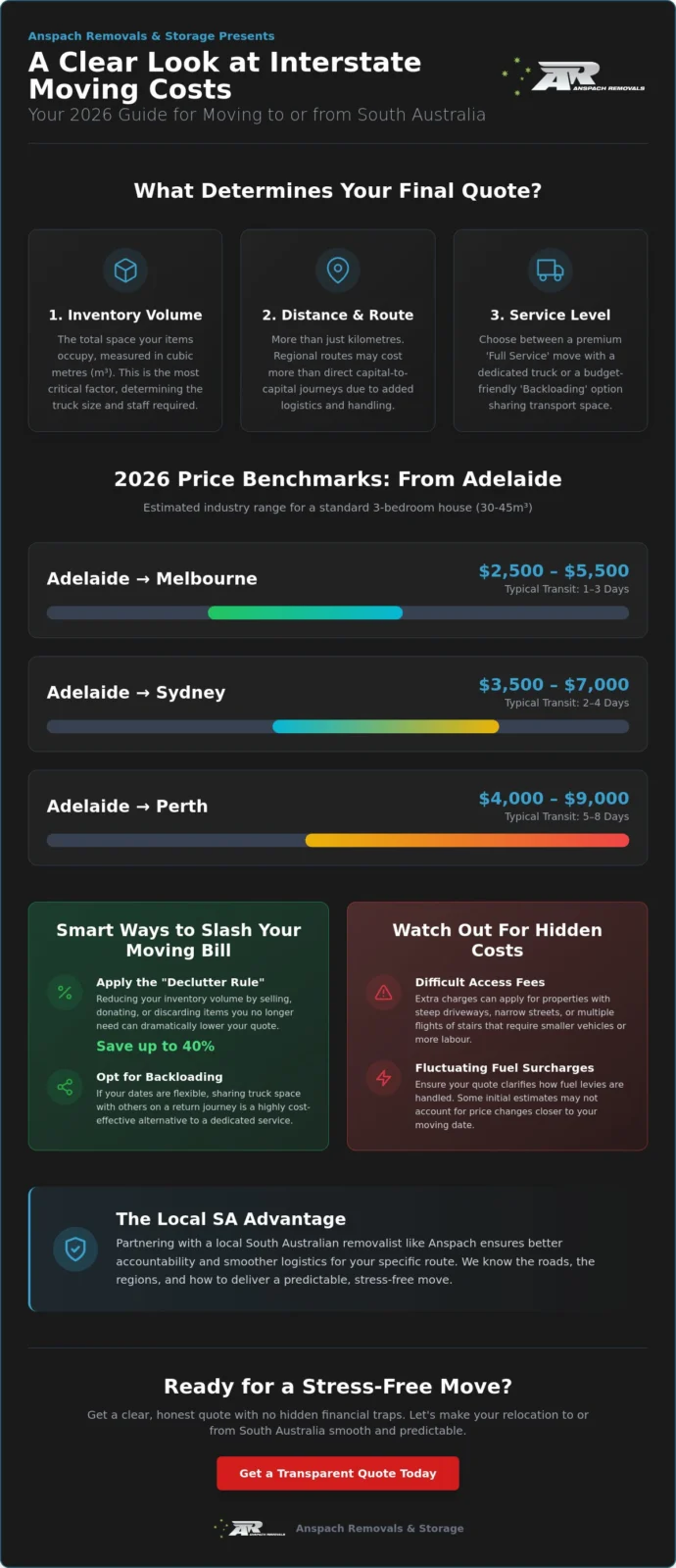
Understanding the interstate moving cost South Australia residents face in 2026 requires a look at current market averages. These figures reflect recent increases in labour rates and the operational costs associated with long-distance haulage. It is important to recognise that these are general industry benchmarks and not specific quotes. Your final bill will depend on your inventory volume, which for a standard three-bedroom home typically ranges between 30 and 45 cubic metres. Prices fluctuate based on whether you choose a dedicated truck or a shared load. If you want to understand how local Adelaide pricing compares before committing to an interstate budget, our detailed breakdown of how much do removalists cost Adelaide families in 2026 provides a useful baseline for your planning.
| Route (from Adelaide) | Industry Benchmark Range (3-Bed House) | Typical Transit Time |
|---|---|---|
| Adelaide to Melbourne | $2,500 – $5,500 | 1–3 Days |
| Adelaide to Sydney | $3,500 – $7,000 | 2–4 Days |
| Adelaide to Perth | $4,000 – $9,000 | 5–8 Days |
A ‘Full Service’ move provides you with a dedicated truck and a specific delivery window, offering the highest level of security for your valuables. If your budget is tighter and your dates are flexible, backloading is an excellent alternative. By sharing truck space with other customers on return journeys, you can often reduce your interstate moving cost South Australia by up to 40% while still receiving professional handling.
Adelaide to Eastern States (VIC & NSW)
The Adelaide-Melbourne corridor remains the most cost-effective interstate route from South Australia due to the high volume of freight moving along the Western Highway. Moving to Sydney presents a different set of challenges. While the distance is manageable, Sydney’s geography often includes ‘difficult access’ suburbs. Narrow streets in the Inner West or steep driveways in the Northern Beaches can require smaller ferry vehicles, which adds to the labour cost. Following AFRA’s official moving tips can help you prepare for these logistical hurdles and avoid last-minute surprises on your invoice.
The Long Haul: Adelaide to WA or QLD
Moving across the Nullarbor to Perth is a significant logistical undertaking. The vast distances between service points and fluctuating fuel prices in remote areas directly impact the final quote. Similarly, moves from Adelaide to Brisbane are considered ‘long haul’ and often require more transit days to navigate the inland routes safely — if you’re planning this journey, our dedicated guide for Adelaide to Brisbane removalists covers everything from backloading strategies to biosecurity rules for 2026. For those starting their journey outside the city, such as Mount Gambier removalists handling Limestone Coast relocations, the cost will also reflect the additional distance to reach the main interstate freight hubs. If you are starting to plan your budget, we can help you organise your interstate journey with a clear understanding of these regional factors.
Hidden Costs: What Your Initial Quote Might Not Tell You
Have you ever wondered why two identical houses moving to the same street can have vastly different final bills? It’s usually because the initial quote only covers the basics. To truly master your interstate moving cost South Australia, you need to look beneath the surface. Unexpected hurdles at either end of the trip can quickly inflate your expenses if they aren’t disclosed upfront. We believe in transparency, so let’s shed some light on the extras that often catch families off guard. Being prepared for these costs now means you won’t be scrambling for extra funds later.
Access Issues and Special Items
The layout of your home is just as important as the items inside it. If your property has three flights of stairs, a narrow driveway that won’t fit a semi-trailer, or requires a long walk from the kerb to the front door, you will likely face ‘Difficult Access’ fees. In the Adelaide Hills, for example, many properties have steep or winding entries. This often requires a ‘ferry vehicle’, which is a smaller truck used to shuttle your belongings from the house to the larger interstate van. It’s a double-handling process that adds to the labour time. Heavy or awkward items like pianos, pool tables, and oversized safes also attract surcharges due to the specialist equipment and extra manpower needed to move them safely. Investing in professional packing Adelaide services can actually mitigate some of these risks by ensuring items are properly protected, reducing the chance of damage surcharges during transit.
Fuel surcharges are another factor that can shift your final price in 2026. Because fuel prices fluctuate so frequently, many removalists add a percentage-based surcharge to the base rate. We recommend asking your mover how they calculate this and if you can lock in a specific rate at the time of booking to avoid surprises. If your new home isn’t ready the moment the truck arrives, you may also need to budget for ‘Storage-in-Transit’. This includes the cost of unloading your goods into a secure facility and then reloading them for final delivery once you get the keys.
Insurance: Protecting Your Assets
Do not assume your standard home and contents policy covers your belongings once they leave your property. Most policies stop at the front door. Transit insurance is a separate and necessary expense for any interstate move. There is a significant difference between ‘Total Loss’ cover, which only pays out if the entire truck is lost, and ‘Full Replacement’ cover, which protects individual items against chips, dents, or breakages. While ‘Public Liability’ is a standard requirement for any reputable business, it only covers damage to the property or injury to people, not your actual furniture. Factoring these premiums into your total budget ensures you have the peace of mind that your life’s work is protected over those thousands of kilometres.
Money-Saving Strategies for Your Interstate Relocation
What if you could cut your interstate moving cost South Australia by nearly half simply by changing your perspective? Many families treat their moving quote as a fixed, unavoidable expense. In reality, you have several levers to pull that can significantly reduce the final figure. Taking control of your budget starts with the ‘Declutter Rule’. Moving items you no longer use is quite literally throwing money away. Every old fridge in the shed or box of clothes in the attic adds cubic metres to your inventory, which increases the truck size and labour required. If you haven’t used it in the last twelve months, consider selling or donating it before the removalists arrive.
Timing is another powerful tool. Most people try to move on a Friday or at the very end of the month to align with lease handovers. This creates a massive spike in demand. If you can negotiate a mid-week or mid-month move, you might find more competitive rates. Similarly, avoid school holiday periods when interstate routes are at their busiest. For smaller items, you can save on packing materials by using your own linens, towels, and blankets as padding for fragile goods instead of buying rolls of expensive bubble wrap.
The Power of Backloading in SA
Backloading is one of the most effective ways to slash your relocation bill. This process involves booking space on a truck that is already travelling to your destination to complete another job or is returning empty from a previous delivery. By sharing the overheads of the journey with other customers, you can often save up to 40% on your move. It is a fantastic option for students leaving Adelaide or for households with only a few rooms of furniture. The trade-off is flexibility. Because you are piggybacking on an existing route, you may have less control over the exact pick-up and delivery times. If your schedule allows for a bit of wiggle room, the financial benefits are hard to ignore.
DIY vs. Professional Packing
Deciding whether to pack yourself is a classic ‘time versus money’ trade-off. Packing a whole house can take weeks of your life, but it does remove the professional packing fee from your quote. If you choose the DIY route, you can further lower costs by sourcing quality moving boxes in Adelaide rather than relying on flimsy supermarket cartons that might collapse in transit. However, keep in mind that many insurance providers only offer full replacement cover if the items were packed by professionals. A professional team uses standardised techniques that minimise movement inside the truck, which can actually lower your insurance premiums and prevent costly breakages. If you want to see exactly how much you could save with these strategies, request a transparent quote from our team today.
Why a Local South Australian Removalist Offers Better Value
Choosing a removalist involves more than just comparing the lowest numbers on a screen. While we’ve explored the variables that make up the interstate moving cost South Australia families face, the true value lies in the accountability of the team behind the truck. National aggregators often boast about massive networks, but they frequently outsource the actual lifting to subcontractors you’ve never met. This creates a disconnect when you need answers. By choosing a local South Australian operator, you’re partnering with people who know our regional roads and Adelaide’s unique suburban layouts intimately.
We don’t believe in call centre runarounds or automated scripts. You get direct contact with a team that takes personal responsibility for your belongings from the moment they’re wrapped until they’re placed in your new home. Whether you’re navigating the narrow, leafy streets of the eastern suburbs or coordinating a long-haul trek from the Eyre Peninsula, local knowledge prevents the logistical hiccups that often lead to extra fees. It’s about having a support partner who understands that a move isn’t just about shifting boxes; it’s about transitioning your entire life with confidence.
The Anspach Family Difference
Anspach Removals & Storage has spent over 20 years building a reputation for reliability within the South Australian community. As a family-owned business, our commitment to the state goes beyond simple logistics. When you book with us, your money stays within the SA economy, supporting local jobs and regional growth. We’ve seen every type of interstate challenge over the last two decades and have used that experience to refine our ‘no-surprises’ quoting process. We provide transparent figures that account for the 2026 economic landscape, ensuring your interstate moving cost South Australia remains exactly what was agreed upon before the first item is loaded.
Ready to Start Your Move?
A successful relocation is built on thorough preparation and clear communication. To help you stay on track during this busy transition, we encourage you to use our moving address checklist, which covers every essential step for a South Australian move. Once you’re ready to get a concrete figure for your budget, the best next step is a personalised site visit. This allows us to see your inventory firsthand and provide a fixed-price quote that eliminates the guesswork. Get a free, no-obligation interstate moving quote from Anspach Removals & Storage today and let our family look after yours.
Secure Your Seamless Move to or from South Australia
Relocating your life across state lines is a significant milestone that deserves a professional, empathetic touch. You now understand how inventory volume, route logistics, and smart strategies like backloading influence the final interstate moving cost South Australia families can expect in 2026. By focusing on an accurate inventory and choosing a local expert, you avoid the hidden traps of anonymous national networks. You gain the security of a team that knows every corner of our state and treats your belongings with the respect they deserve.
Since 2002, Anspach Removals & Storage has remained proudly South Australian owned and operated. We are specialists in regional and interstate relocations, offering specialised packing and secure storage options to protect your assets during the long haul across the border. Don’t let the fear of hidden fees or transit stress overshadow your fresh start. Request a Personalised Interstate Moving Quote today for a transparent, fixed-price plan tailored to your specific journey. We look forward to guiding you home with the care and precision your move requires.
Frequently Asked Questions
How much does it cost to move a 3-bedroom house from Adelaide to Melbourne?
Moving a standard three-bedroom family home from Adelaide to Melbourne typically costs between $2,500 and $5,500 in 2026. This specific corridor is one of the most cost-effective routes due to the high volume of freight moving along the Western Highway. Your final figure depends on the total cubic metres of your inventory and whether you opt for a dedicated truck or a shared backloading service.
Is it cheaper to move interstate on a weekday in South Australia?
Yes, booking your move for a mid-week window is generally cheaper than choosing a weekend or the end of the month. Most removalists experience a surge in demand on Fridays and Mondays as people try to align with lease handovers. By scheduling your relocation for a Tuesday or Wednesday, you can often secure more competitive rates and have greater flexibility with your preferred pick-up times.
What is the average fuel levy for interstate moves in 2026?
Fuel levies in 2026 are usually calculated as a percentage of the base rate and vary based on current diesel prices at the time of transit. These surcharges help cover the operational costs of long-haul trips, especially on routes like the Nullarbor. We recommend asking for a transparent breakdown of how this levy is calculated to ensure your interstate moving cost South Australia remains within your planned budget.
Can I save money by packing my own boxes for an interstate move?
You can save between $400 and $800 on your relocation by choosing to pack your own boxes rather than using professional packing services. While this is a great way to lower the initial quote, it’s important to remember that most transit insurance policies only provide full replacement cover for items packed by professionals. You’ll need to weigh the immediate cost savings against the long-term protection of your valuables.
How long does a move from Adelaide to Perth usually take?
A standard relocation from Adelaide to Perth typically takes between 5 and 8 days to complete. This timeframe allows for the vast distance across the Nullarbor and ensures that drivers can take mandatory safety breaks. If you are using a shared load or backloading service, the timing may be slightly longer to accommodate multiple pick-ups and deliveries along the way, so it’s best to plan accordingly.
Does Anspach Removals & Storage provide fixed-price quotes for interstate moves?
Anspach Removals & Storage provides fixed-price quotes following a comprehensive site visit or a detailed inventory assessment. We believe in total transparency, ensuring the price you’re quoted is the price you pay on moving day. By assessing your specific access requirements and volume upfront, we eliminate the hidden fees that often inflate the interstate moving cost South Australia families pay when using less reputable operators.
What items are not allowed on an interstate removalist truck?
Prohibited items include hazardous materials such as gas bottles, ammunition, and flammable liquids, along with specific organic materials restricted by South Australian biosecurity laws. Because we are protecting our local agricultural industries, you cannot bring certain fruits, vegetables, or plants across the border. All outdoor equipment must also be cleaned of soil before loading to comply with fruit fly prevention regulations and quarantine requirements.
Is transit insurance mandatory for moves leaving South Australia?
Transit insurance isn’t legally mandatory, but it is highly recommended for any move crossing state borders. Standard home and contents insurance usually stops at the front door and won’t cover breakages that occur in a moving truck. Investing in specific transit cover ensures that your belongings are protected against accidental damage or loss during the thousands of kilometres of travel between your old and new homes.