
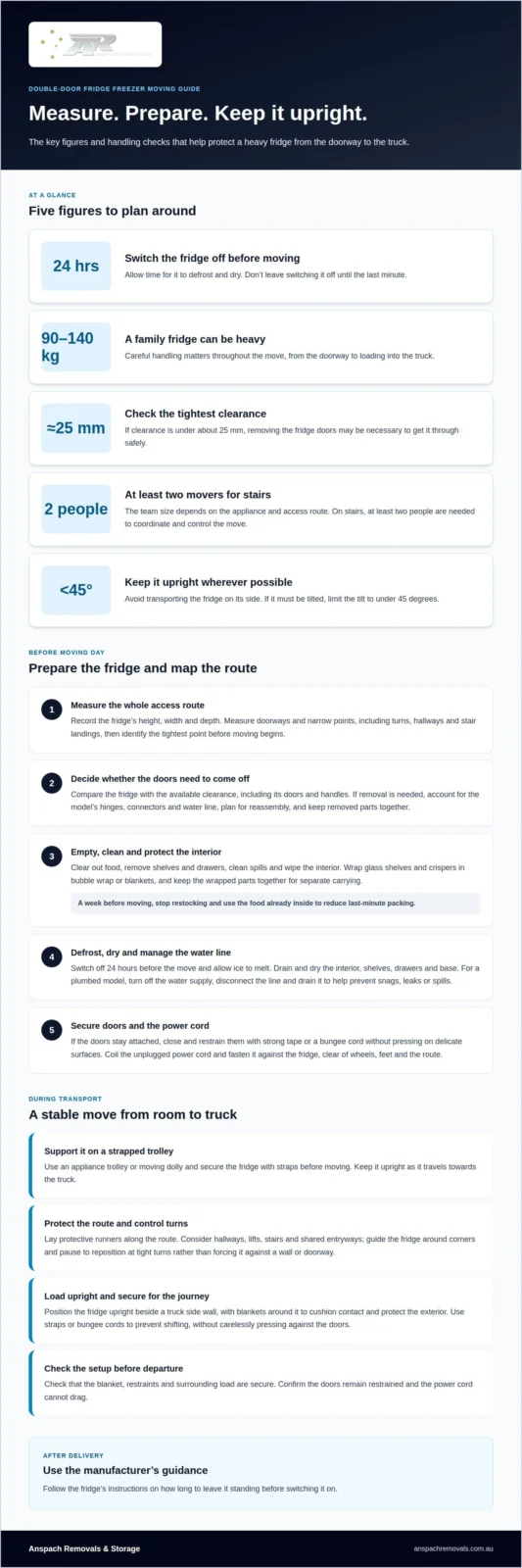
The fridge should be switched off 24 hours before moving, not just unplugged at the last minute. If you’re planning how to move a double door fridge freezer, allow time for it to defrost and dry, then keep it upright during transport. A family fridge can weigh 90 to 140 kg, so careful handling matters from the doorway to the truck.
It’s understandable to worry about tight access, heavy lifting and damage to the appliance. The safest approach starts with measuring the route, including doorways, and deciding whether the fridge doors need to come off for clearance.
Professional movers assess access, protect the appliance for loading and transport it upright where possible. Before the move, share the fridge’s dimensions, location and any obstacles along the route. After delivery, follow the manufacturer’s instructions on how long to leave it standing before switching it on.
Key Takeaways
- Professional movers assess the full access route and use the available clearance to plan the safest way through.
- Thoughtful preparation protects removable shelves, drawers and water connections before the fridge is moved.
- Correct trolley handling and secure positioning help keep the appliance stable throughout transport.
- Keeping the fridge upright where possible, and following its manual after delivery, helps guide when it’s ready to use again.
How professional movers measure doorways and decide whether to remove fridge doors
There’s no single crew size for every double-door fridge freezer. The team needed depends on the appliance and the access route. At least two people are needed to move it on stairs.
- Measure the complete route. Movers record the fridge’s height, width and depth, then measure door openings and narrow points along the path. They include turns, hallways and stair landings, where a fridge may need extra room to pivot. A clear route measurement helps identify the tightest point before moving begins.
- Compare the fridge with the available clearance. Movers assess whether the appliance can pass without catching its doors or handles. If clearance is under about 25 mm, removing the fridge doors may be necessary. The decision also considers whether the fridge can be manoeuvred safely through the opening without scraping walls or damaging hinges.
- Plan door removal around the model. If the measurements show the fridge won’t pass safely, movers consider removing its doors to reduce its width. They account for hinges, connectors and any water line before detaching parts. A model’s construction affects the process, so the team plans for reassembly and keeps removed components together.
- Secure both doors before moving. When the doors stay attached, movers close them and secure them with strong tape or a bungee cord. They place the restraint so it holds the doors shut without pressing against delicate surfaces. This prevents the doors swinging open while the fridge is being manoeuvred through a doorway.
- Secure the power cord and check the load. Movers coil the unplugged cord and fasten it against the fridge, keeping it clear of wheels, feet and the route. Before lifting, they check that the doors remain restrained and the cord cannot drag. For a stair route, at least two people coordinate the movement and maintain control together.
How Long Should The Fridge Be Off Before Moving?
Movers switch the fridge off 24 hours before moving, allowing it to defrost and dry. They then prepare the interior and, for plumbed models, disconnect and drain the water line.
- Plan the shutdown. Movers arrange the 24-hour shut-off before collection, rather than leaving defrosting until moving day. This gives ice time to melt and moisture time to dry. For a plumbed fridge, they also plan to turn off the water supply before disconnecting the line.
- Empty and clean the interior. The fridge is cleared of food, then its shelves and drawers are removed. Movers clean spills and wipe the interior, since leftover food or liquid can spread during transport. A week before moving, stop restocking and use the food already inside to reduce last-minute packing.
- Protect removable parts. Glass shelves and crispers are taken out and wrapped in bubble wrap or blankets. This keeps loose pieces from shifting and reduces the chance of breakage. Movers keep the wrapped components together, ready to be carried separately from the appliance.
- Defrost and dry thoroughly. Once switched off, the fridge needs time for ice to melt. Movers allow water to drain, then dry the interior and removable areas before transport. Any remaining moisture can spill as the appliance moves, so the team checks shelves, drawers and the base for damp patches.
- Disconnect plumbed models carefully. Movers turn off the water supply, disconnect the line and drain it before moving the fridge. Moving without disconnecting the line can cause it to snag or leak, spilling water and potentially damaging the appliance or nearby surfaces. Draining the line also prevents trapped water escaping during handling.
For a move involving several household items, professional moving support can help coordinate the preparation and transport.
How professional movers secure the fridge in the moving truck
Movers protect floors with protective runners along the route and keep the fridge on a trolley. They guide it around corners and avoid dragging its feet across flooring.
- Position the appliance on a trolley. Movers use an appliance trolley or moving dolly to support the fridge and reduce strain during handling. They secure it with straps before moving, keeping it upright as it travels from the kitchen towards the truck.
- Control movement through apartments. The team considers hallways, lifts, stairs and shared entryways before choosing the route. On stairs, movers coordinate each movement and keep the appliance stable. At tight turns, they pause and reposition rather than force the fridge against a wall or doorway.
- Protect floors and nearby surfaces. Movers lay protective runners along the route, especially across vulnerable flooring and high-traffic areas. They keep the trolley wheels clear of loose debris that could mark a floor. At corners, careful handling helps prevent the fridge, trolley or straps from scraping walls and door frames.
- Load the fridge upright against a truck wall. Once inside, movers position the appliance upright beside a side wall. They place blankets around it to cushion contact with the truck and help protect its exterior. The position also gives the team a stable base for securing the fridge.
- Secure it for the journey. Movers use straps or bungee cords to hold the fridge in place and prevent shifting during transit. They check that restraints hold the appliance securely without pressing carelessly against its doors. A final inspection checks the blanket, straps and surrounding load before the truck departs.
Can You Transport A Fridge Laying Down?
Keep a fridge upright during transport wherever possible. A safe plan for how to move a double door fridge freezer starts by avoiding transport on its side and limiting any necessary tilt to under 45 degrees.
How professional movers transport the fridge upright or tilted
Choose upright transport first, and avoid laying the fridge flat. Movers use an appliance trolley to control its position along the route and towards the truck. If a brief tilt is needed to negotiate access, they keep it under 45 degrees wherever possible. When planning how to move a double door fridge freezer through a tight access point, movers minimise the tilt rather than treating it as the standard position.
How professional movers keep the fridge upright
Keep the fridge upright throughout the journey. In the truck, movers position it upright against a side wall, then secure it with straps and protective blankets. They check its position before departure, since shifting could leave the appliance tilted. The route and loading plan should support upright transport from collection to delivery.
- Choose the upright position first. Movers plan the route and truck loading around keeping the appliance vertical. The Good Guys advises transporting a fridge upright rather than laying it down.
- Limit any tilt during handling. Where a short tilt is needed, keep it under 45 degrees wherever possible. Avoid continuing the journey with the fridge tilted.
- Allow for standing time after a tilt. After a brief tilt under 45 degrees, leave the fridge unplugged for at least 4 hours before switching it on. Check the model manual, as manufacturer guidance on standing time differs.
- Follow the model manual after delivery. Use the manual’s standing-time guidance for that fridge before plugging it in. This avoids assuming every model needs the same wait.
For careful upright handling during your move, arrange professional fridge freezer transport.
Anspach Removals & Storage
Anspach Removals can manage the lifting and transport planning when a double-door fridge freezer is part of your move. For Adelaide local moves, country moves across South Australia and interstate relocations, the team can include the fridge’s access route and careful handling in the wider plan. Anspach also handles office and commercial relocations involving large fridges.
Share the fridge’s location, destination and any access challenges, such as narrow hallways or stairs. These details help the move plan account for the appliance alongside your other belongings. If you’re organising a move and would like support with the fridge, contact Anspach Removals & Storage to discuss your requirements.
Make your next move easier to plan
A double-door fridge freezer is a significant part of a move, but it doesn’t need to dictate every other decision. Include its transport in the wider moving-day plan so access, appliance handling and the arrival of your household belongings can be coordinated together.
If you’re planning how to move a double door fridge freezer as part of an Adelaide, country or interstate relocation, Anspach Removals can organise the wider household move around your requirements. Request a written quote to discuss your move and the arrangements for transporting the fridge.
Discuss your move with Anspach Removals & Storage, and take the next step with a clear plan.
Frequently Asked Questions
Upright or on its side?
Transport a fridge freezer upright wherever possible. Laying it on its side is not the preferred method, so movers plan the route and truck space to avoid it. If a short tilt is needed to get through a tight access point, keep it under 45 degrees where possible. The appliance’s manual can clarify the manufacturer’s guidance for its particular model.
How do professional movers prepare a double-door fridge freezer for moving?
Movers plan preparation around collection time and the fridge’s features. They switch it off 24 hours beforehand, empty and clean its interior, and remove shelves and drawers for separate protection. For a plumbed model, they turn off the water supply, disconnect the line and drain it. Using food already inside during the week before moving can also reduce what needs clearing.
How do professional movers remove fridge freezer doors safely for transport?
Movers assess whether the fridge can pass through the route with its doors attached. If they need to remove them, they consider the model’s hinges and any connected wiring or water line before detaching anything. They protect the doors and loose components from knocks and keep them together for reassembly. This avoids forcing the appliance through a tight opening.
What moving equipment do professionals use for a large fridge freezer?
Movers use an appliance trolley or moving dolly to support and manoeuvre the fridge, with straps to keep it steady. Protective blankets help shield its exterior during loading and transport. In the truck, they secure the upright appliance against a side wall. At least two people are needed to coordinate the move and maintain control on stairs.
Can you transport a fridge freezer on its side in Australia?
It’s best to transport a fridge freezer upright in Australia, rather than on its side. If the route requires a brief tilt, keep it under 45 degrees wherever possible and avoid carrying it tilted for the journey. After a brief tilt under 45 degrees, leave it unplugged for at least 4 hours before switching it on, and follow the model manual.
How long should a fridge freezer stand upright before plugging it in after moving?
Follow the standing-time instructions in the fridge freezer’s model manual, because manufacturer guidance differs. After a brief tilt under 45 degrees, leave the appliance unplugged for at least 4 hours before switching it on. If it travelled upright, use the manual’s instructions rather than assuming the same wait applies to every model. Check the manual before reconnecting power.