
What if settlement goes through before you can get the keys to your new home? Moving house when settlement dates don’t align can leave you juggling temporary accommodation, a last-minute move and a safe place for your belongings. It’s a stressful gap, but a clear plan can keep it manageable.
If you need to leave one home before you can move into the next, your options depend on how long the gap is and when you’ll have access to each property. This guide compares practical ways to bridge it, from discussing a settlement change or temporary accommodation to using storage and moving in stages. You’ll also find steps for coordinating removalists, packing and everyday essentials so you can avoid rushed decisions.
For Adelaide households, a shared timeline can turn uncertainty into a more manageable move. Anspach Removals & Storage is a South Australian-owned family business established in 2002, providing moving, packing and secure storage services. Read on to find an approach that suits your dates and helps protect your belongings during the transition.
Key Takeaways
- Settlement and moving day don’t have to be the same. Distinguish the transfer of ownership from when you can access and occupy each home.
- For moving house when settlement dates don’t align, compare options such as rescheduling, temporary accommodation, agreed early access and storage against your dates and household needs.
- Check which arrangements depend on contract terms or agreement from other parties before including them in your plan.
- Anchor your moving schedule to confirmed access dates, then plan collection, storage and final delivery around them.
- A staged move with packing and secure storage can help protect your belongings while you wait for the new home to be ready.
Moving house when settlement dates don’t align: what the gap means
Settlement day and moving day don’t have to be identical. If you’re moving house when settlement dates don’t align, separate the completion of each property transaction from the practical question of when you can enter and occupy each home. Then work out where your household will stay and where your belongings can go during the gap.
In Australia, settlement is generally when the property transaction is completed and ownership transfers. Access and possession depend on the contract and any agreed arrangements. A date written into a contract is a planned settlement date, but it doesn’t, by itself, confirm whether you can move belongings in earlier or remain in a home afterwards. Check the arrangements for each property rather than assuming the dates give you access.
Why settlement and move-in dates can differ
Your sale and purchase are separate transactions, each with its own timeline. If your sale settles first, you may need to leave before the next home is ready. If the purchase settles first, you might have access to the new property while still living in the old one, creating an overlap that could allow a staged move. If either date shifts, arrangements you’ve already made may need to change. Don’t treat a scheduled date as guaranteed access.
Check the contract and agreed arrangements for each property to understand when access and possession are expected. A settlement date and permission to enter are related, but they’re not interchangeable. If you’re unsure what a contract term means or what a date change could mean for you, speak with your conveyancer or solicitor. This is general planning information, not legal advice.
First questions to answer before choosing a plan
Gather the practical details before deciding how to bridge the gap. Confirm the current settlement dates with the people managing each transaction, then establish when you’re expected to leave the old property and when you can access the new one. If dates change, update your plan rather than relying on an earlier schedule. These details help you match accommodation and moving arrangements to the access window you can plan around.
- Which dates are confirmed? Record the expected settlement dates for both properties, plus the agreed handover and access arrangements.
- How long might you be between homes? Work out whether you need temporary accommodation and, if so, how many nights you may need it for.
- What must stay close at hand? Set aside medication, important documents, daily clothing and items needed for work or children.
- What can be stored? Identify furniture, boxes and less-used belongings that can wait until you have access to the new home.
These answers will show whether your main challenge is accommodation, access, belongings or a combination of all three. Use that to choose an arrangement that fits your household, rather than trying to force every part of the move into one day.
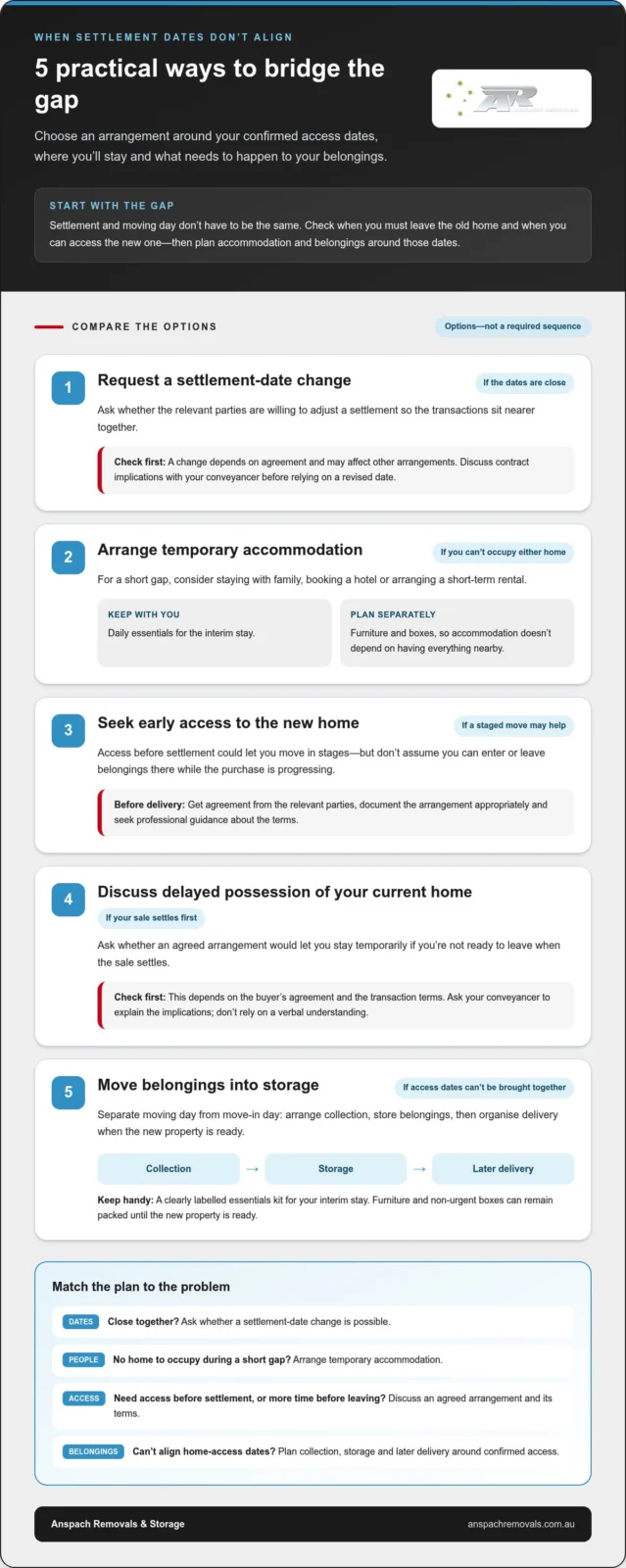
Five practical ways to bridge a settlement-date gap
There isn’t one right answer for moving house when settlement dates don’t align. The best fit depends on how long the gap is, whether you can access either property and what arrangements the other parties agree to. Treat each option as a possibility, not an automatic entitlement. Contract terms and any changes to settlement or access need careful attention.
- Request a settlement-date change. If the dates are close, ask whether the relevant parties are willing to adjust one settlement so the transactions sit nearer together. A change may simplify the move, but it depends on agreement and can affect other arrangements. Discuss the contract implications with your conveyancer before relying on a revised date.
- Arrange temporary accommodation. If you can’t occupy either home during a short gap, staying with family, booking a hotel or arranging a short-term rental may cover the nights between moves. Keep daily essentials with you and plan separately for furniture and boxes, so your accommodation doesn’t depend on having all your belongings nearby.
- Seek early access to the new home. Access before settlement could help you move in stages, but don’t assume you can enter or leave belongings there just because the purchase is progressing. Any early-access arrangement needs agreement from the relevant parties and should be documented appropriately. Get professional guidance about the terms before scheduling delivery.
- Discuss delayed possession of your current home. If your sale settles before you’re ready to leave, ask whether an agreed arrangement would allow you to stay temporarily. This depends on the buyer’s agreement and the transaction terms. Have your conveyancer explain the implications rather than relying on a verbal understanding.
- Move belongings into storage. If the home-access dates can’t be brought together, collection followed by storage and later delivery separates moving day from move-in day. Keep a clearly labelled essentials kit for your interim stay, while furniture and non-urgent boxes remain packed until the new property is ready.
Temporary accommodation, early access or a settlement change
These options solve different problems. Temporary accommodation covers the people; early access or a settlement change may help align access to the homes. In Australia, discuss proposed changes and contract implications with your conveyancer, and have agreed arrangements documented through the appropriate process. Don’t rely on an assumed right to stay, enter or move belongings before access has been agreed.
Staged moving and storage between homes
Storage can make a gap easier to manage even when dates can’t change. Pack a separate set of clothes, medication, chargers, children’s essentials and important documents for the interim, then label boxes by room and priority. The rest can stay packed until delivery. For guidance on protecting belongings in storage, see this secure storage Adelaide guide.
In short: request a date change when the relevant parties can agree; use temporary accommodation for a brief gap; seek agreed early or delayed access when it suits everyone; and choose staged moving with storage when your belongings need a place between homes. Anspach Removals & Storage provides moving, packing and storage services to help organise collection, storage and delivery around your access dates.
How to compare settlement-gap options and choose what suits you
Compare each option against what it actually solves: a place to stay, access to a home, or somewhere for your belongings. The most convenient arrangement on paper may not suit your household if it relies on access that hasn’t been agreed. Use the table to weigh certainty, moving stages and day-to-day disruption before settling on a plan.
| Option | Access certainty | Move stages | Household disruption and coordination |
|---|---|---|---|
| Temporary accommodation | Doesn’t rely on access to the new home, but you’ll need to arrange somewhere to stay. | May mean belongings go to storage or a temporary location before final delivery. | Can suit a brief gap; coordinate accommodation, essentials and belongings separately. |
| Rescheduling settlement | Depends on agreement between the relevant parties and the revised arrangements. | Could bring the dates closer and simplify the move if agreed. | May reduce disruption, but changes need careful coordination with the people managing both transactions. |
| Early access | Only available if the relevant parties agree to appropriate arrangements. | May allow a staged move into the new home. | Can reduce the time belongings are elsewhere, but depends on confirmed access and clear coordination. |
| Storage | Separates the belongings’ collection from access to the new home. | Usually involves collection, storage and later delivery. | Can keep a home clear during a longer or uncertain gap; plan essentials separately. |
There’s no universal cost comparison: expenses depend on your accommodation, transaction arrangements, storage needs and moving plan. Compare the full practical impact, not just the number of days between settlements.
Choose according to the length and certainty of the gap
For a brief, clearly defined gap, temporary accommodation may be simpler than rushing the whole household into a new home. If access dates are uncertain, favour a plan that doesn’t depend on entering a property before permission is confirmed. For a longer gap, consider whether storing most belongings and keeping only daily essentials with you will make the interim easier.
Factor in household needs and moving complexity
Think beyond the calendar. Children may need familiar items close by; pets and work commitments can affect where you stay and how you organise the transition. List medication, chargers, documents and daily-use items to keep accessible. Bulky furniture and fragile belongings may need professional packing and handling, especially if they’ll be moved more than once.
For country or interstate moves, factor in travel and delivery coordination alongside the access dates. A useful decision rule: match the plan to the gap length, rely only on confirmed access, and keep essential belongings available for every stage. That’s a steadier way to manage moving house when settlement dates don’t align.
Plan the move step by step when settlement dates differ
A clear timeline helps everyone work from the same information, especially if a settlement or access date changes. For moving house when settlement dates don’t align, organise the plan around what’s confirmed, sort belongings by when you’ll need them, and share updates promptly with everyone coordinating the move.
Confirmed access dates should anchor your moving schedule, because a settlement date alone doesn’t guarantee you can enter either property.
Before settlement: confirm dates and organise the move
- Build one shared timeline. Record the expected settlement dates, when you’re due to hand over the old home, when you can access the new one, and any dependencies between the dates. Keep the latest version somewhere household members and relevant coordinators can refer to it.
- Mark what’s confirmed. Separate agreed dates and access arrangements from tentative plans. If a date changes, pass the update on promptly to your conveyancer, accommodation contacts and moving coordinator, then check which bookings or arrangements need to be adjusted.
- Decide where you’ll stay and what you’ll need. If there’s a gap without access to a home, organise suitable interim accommodation. Set aside medication, important documents, chargers, work items and a small supply of everyday essentials rather than packing them with belongings that will be stored.
- Plan collection and delivery around access. Decide which belongings go to the new home, which need storage and which must stay with you. Arrange packing, removal, storage and final delivery to fit the confirmed access plan, not an assumed early entry date.
During the gap: keep essentials accessible and plans current
- 5. Keep an essentials bag with you. Include daily-use items for each household member, along with anything needed for work or caring responsibilities. This avoids searching through packed boxes while you’re between homes.
- 6. Track changes and tell the right people. If settlement or access details shift, update the shared timeline and promptly notify everyone whose arrangements depend on them. Don’t assume a change has reached your removal coordinator or accommodation contact.
- 7. Check the split before collection. Confirm which boxes and furniture are headed to storage and which items need to go to your interim address. Clear labels and a simple inventory can help prevent essential belongings being packed away by mistake.
- 8. Arrange final delivery when access is ready. Once you have a confirmed time to enter the new home, coordinate delivery and identify any items that should be unloaded first. For Adelaide households planning a local move, the local removalists Adelaide guide offers more advice on organising the move.
A staged move may involve more coordination than a single delivery, but a current timeline makes each handover easier to manage. Anspach Removals & Storage provides removal, packing and storage services for Adelaide moves. Plan your Adelaide move with Anspach Removals & Storage.
How Anspach Removals & Storage can help with a settlement gap
A gap between settlement and access can leave you coordinating several moving parts at once. Anspach Removals & Storage helps Adelaide households plan removal, packing and secure storage around confirmed dates. Instead of trying to move every item directly into a home that isn’t ready, you can arrange collection first, storage in between and delivery when access is available.
This staged approach lets you organise the household around what’s happening at each address. Belongings can be packed and collected from your current home, with items you won’t need during the gap placed into storage. Keep essential belongings separate for your interim stay, then plan delivery to the new home once access is arranged. The aim is a clear sequence, not a rushed single-day move.
Coordinate removal and storage around confirmed access
Secure storage provides a practical holding point when the new home isn’t ready to receive your furniture and boxes. Packing support can help prepare belongings for collection and make it easier to distinguish items going into storage from those you’ll need straight away. Set aside a labelled group of essentials for daily use, and organise the rest by room or priority for later delivery.
Anspach Removals & Storage is a South Australian-owned family business established in 2002, providing local Adelaide, country and interstate moves, alongside packing and storage. For a settlement gap, these services can be brought together in a single plan: where collection happens, which belongings need storage, and when delivery can be scheduled around your access arrangements. Keep dates and any changes up to date so the moving plan reflects the latest information.
Prepare the details for a useful moving plan
A few details will help shape a practical plan. Gather the collection and destination addresses, expected settlement dates and any confirmed access arrangements. Be ready to explain how much you need stored, whether you’d like packing support, and which belongings must be delivered first. If dates are still subject to change, make that clear so the moving plan can be based on the latest information rather than assumptions.
It can also help to note access considerations at both properties, such as stairs, narrow entries or bulky furniture that may need special handling. Add household priorities, including work equipment, children’s belongings or items needed for daily routines. These details connect the practical requirements of the move with the gap between homes.
If you’re moving house when settlement dates don’t align, you don’t have to coordinate every moving part alone. Share your dates and priorities with Anspach Removals & Storage to organise removal, packing and secure storage around your access arrangements. Get in touch with Anspach Removals & Storage to discuss your move.
Take the next step towards a settled move
A gap between homes can feel uncertain, but your plan doesn’t need every detail to be settled at once. Start with the dates you can rely on, then leave room to adjust the moving arrangements if access changes. Keeping a primary plan and a practical fallback can help you make decisions calmly, rather than trying to solve everything at the last minute.
If moving house when settlement dates don’t align is your situation, focus first on what your household needs between addresses. Think about where you’ll stay, which belongings must remain within reach and what can wait for delivery. Sharing those priorities alongside your moving dates gives your removal and storage plan a clear starting point.
When you’re ready to turn the dates into a workable plan, talk to Anspach Removals & Storage about your moving dates.
Frequently Asked Questions
What should I do if my settlement dates don’t align?
Start by checking the expected settlement dates and the agreed access arrangements for both properties. Then decide whether to request a date change, arrange temporary accommodation, or separate the collection and delivery of your belongings with storage. For moving house when settlement dates don’t align, make a simple fallback plan too, such as where essential items will stay if access is delayed. Discuss contract questions with your conveyancer.
Can I move out before settlement is complete?
You can move your belongings out before settlement if your arrangements allow it, but leaving early doesn’t itself complete the sale or change your obligations under the contract. Check when the property must be vacated and whether anything else needs to remain in place, such as agreed fixtures or keys. If you plan to leave furniture behind or return after moving out, discuss the arrangement with your conveyancer and the relevant parties.
Can I move into a new property before settlement?
Possibly, but don’t assume you can move in or leave belongings there before settlement. Early access needs agreement from the relevant parties, with the arrangement and any conditions clearly documented. Before organising a delivery, ask your conveyancer to explain how the proposed access fits your contract. If early entry isn’t agreed, plan for another place to stay and keep your moving schedule based on confirmed access instead.
Where can I keep my furniture between settlement dates?
You can arrange storage for furniture and boxes until you’re able to access the new home. A removalist with storage services can coordinate collection, storage and later delivery, which may be useful if moving everything twice would be difficult. Keep medication, documents, chargers and a few days’ clothing with you rather than packing them away. If you’re storing items yourself, make sure you can safely access the space and belongings when needed.
Should I move everything into storage if settlement is delayed?
Not necessarily. If you still have lawful access to your current home, it may be practical to leave suitable belongings there until the revised plan is clear. If you must vacate, storage can hold furniture and non-urgent boxes while you keep daily necessities with you. Consider how long access might be delayed, what you’ll need in the meantime and whether another move stage would add extra handling.
Do I have to move house on settlement day?
No. Settlement day and moving day can be separate. Plan your move around when you’re required to leave one property and when you’re permitted to access the next, not simply the date funds and ownership transfer. You might move before settlement, after it, or in stages, depending on your contract and agreed access arrangements. Check those details before booking delivery or arranging to hand over keys.
How should I plan removalists when settlement dates may change?
Share the current dates, access details and any uncertainty with your removalist as early as you can. Explain which belongings may need storage and which must be delivered first, so the move can be organised around the actual plan. Keep conveyancers and other relevant parties informed of date changes, then promptly pass confirmed updates to everyone coordinating the move. Avoid treating a tentative date as guaranteed access when arranging delivery.